

NIELIT’s Cyber Conclave Puts “Cyber Secure Bharat” on the Agenda
India’s cybersecurity community gathered in New Delhi this week to confront a problem that is growing as fast as the country’s digital footprint: how to detect, investigate and prosecute cybercrime. The National Institute of Electronics and Information Technology (NIELIT), under the Ministry of Electronics and Information Technology (MeitY), is hosting the third National Conference on Cyber Security, Digital Forensics & Intelligence (NCCDFI 2026) on November 16 and 17 at the Dr. Ambedkar International Centre on Janpath.
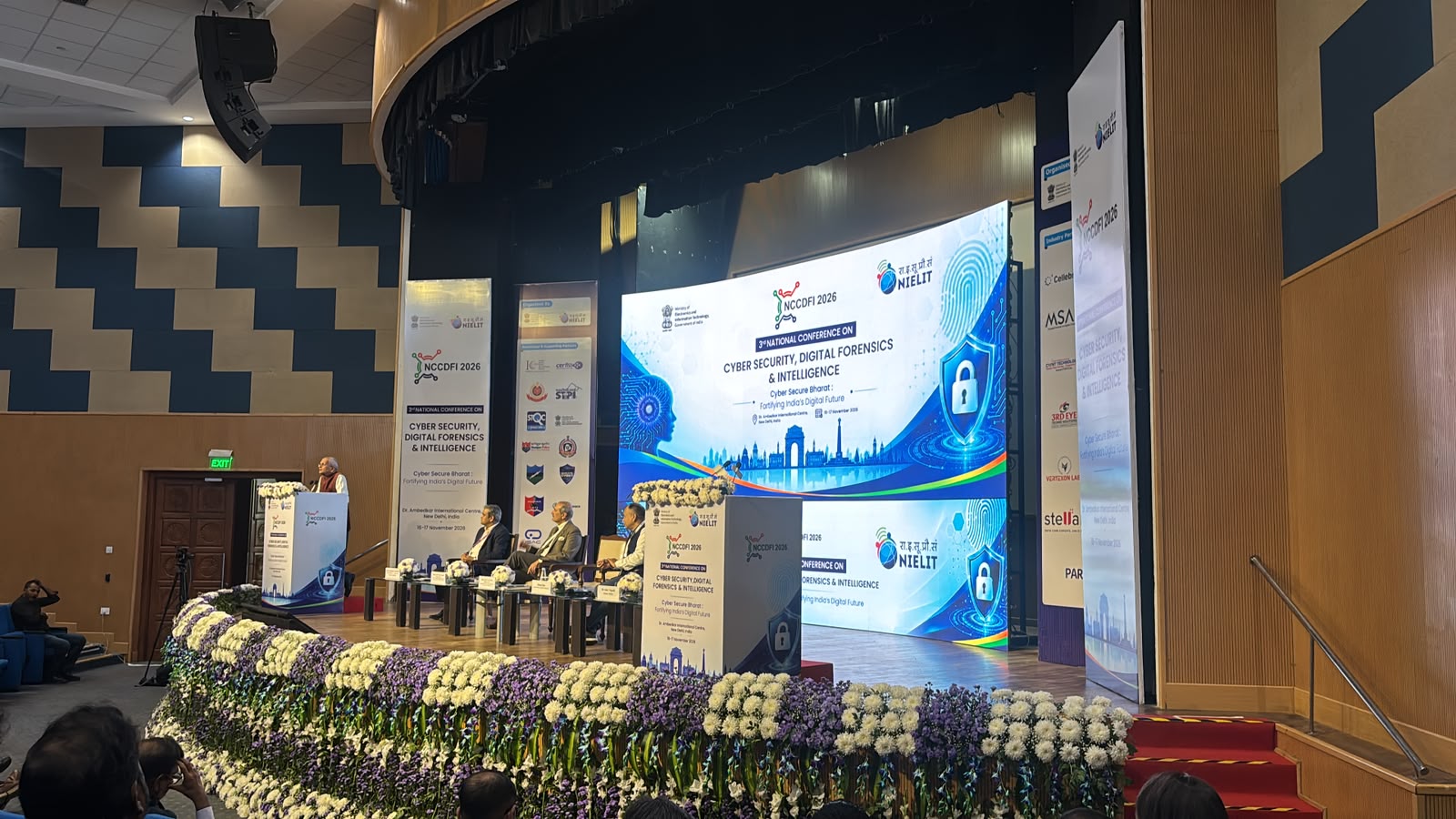
Two days in Delhi bring together government, law enforcement, the judiciary, industry and academia, with two new digital tools and a national AI hackathon final in focus.
India’s cybersecurity community gathered in New Delhi this week to confront a problem that is growing as fast as the country’s digital footprint: how to detect, investigate and prosecute cybercrime. The National Institute of Electronics and Information Technology (NIELIT), under the Ministry of Electronics and Information Technology (MeitY), is hosting the third National Conference on Cyber Security, Digital Forensics & Intelligence (NCCDFI 2026) on November 16 and 17 at the Dr. Ambedkar International Centre on Janpath.
The conference carries the theme “Cyber Secure Bharat: Fortifying India’s Digital Future”. The organisers say growing dependence on digital technologies, increasingly sophisticated cyber threats and the changing nature of cybercrime have made cybersecurity and digital investigations a national priority. The conference brings together government, law enforcement, defence, the judiciary, industry and academia, and aims to strengthen coordination among agencies, build capacity in cybersecurity and digital forensics, and support policy dialogue.
The series began in 2024 with its first edition in Kohima, Nagaland.
Two new tools for digital safety
A highlight of the first day was the launch of two digital applications. CyberVitals is built to identify potential cybersecurity and privacy risks, including malware, unsafe applications and suspicious activity. Net अन्वेषक, developed by NIELIT Gorakhpur, offers network administration features such as device discovery, network monitoring, security assessment and troubleshooting.
Cyber Kushti 2026: where judgement counts
The conference also hosts the final of Cyber Kushti 2026, a national cybersecurity and AI hackathon that runs as the event’s parallel technical track. The competition was launched on August 15, and it is designed to pit human security decisions against AI-generated findings. NIELIT is organising it with the Information Sharing and Analysis Center (ISAC) Foundation under the National Security Database, with CERT-In as knowledge partner. The format has three stages: Review, Attack and Defend.
Participation was strong. The hackathon drew registrations from 1,031 teams comprising 3,093 participants, and 10 teams reached the final. The initiative aims to encourage young innovators to build practical solutions to cybersecurity challenges.
What is on the programme
The conference is organised around 10 thematic tracks. These cover cybersecurity, digital forensics, AI security, critical infrastructure, threat intelligence, blockchain and cryptocurrency, drone and IoT forensics, digital evidence, cyber law and cloud security. Technical sessions address incident response, AI-enabled cyber threats, automated digital investigations, financial cybercrime, advanced device and multimedia forensics, law-enforcement readiness, international cooperation, quantum computing and capacity building. An industry exhibition showcases technologies in digital forensics, cybersecurity, drone technology, surveillance systems and AI-driven security.
The Indian Cybercrime Coordination Centre (I4C) is among the knowledge partners, and industry partners include Magnet Forensics, MSAB and Oxygen Forensics.
From dialogue to collaboration
NIELIT has also signed MoUs with partner organisations to promote joint research, technology development, specialised training and knowledge exchange. The agreements are intended to advance collaboration, research and capacity building in cyber security and digital forensics.
For India, the stakes are practical. Investigators need trained forensic professionals, courts need credible digital evidence, and industry needs a workforce that can handle AI-driven threats. The conference positions NIELIT as the link between those needs and the people who can meet them.