


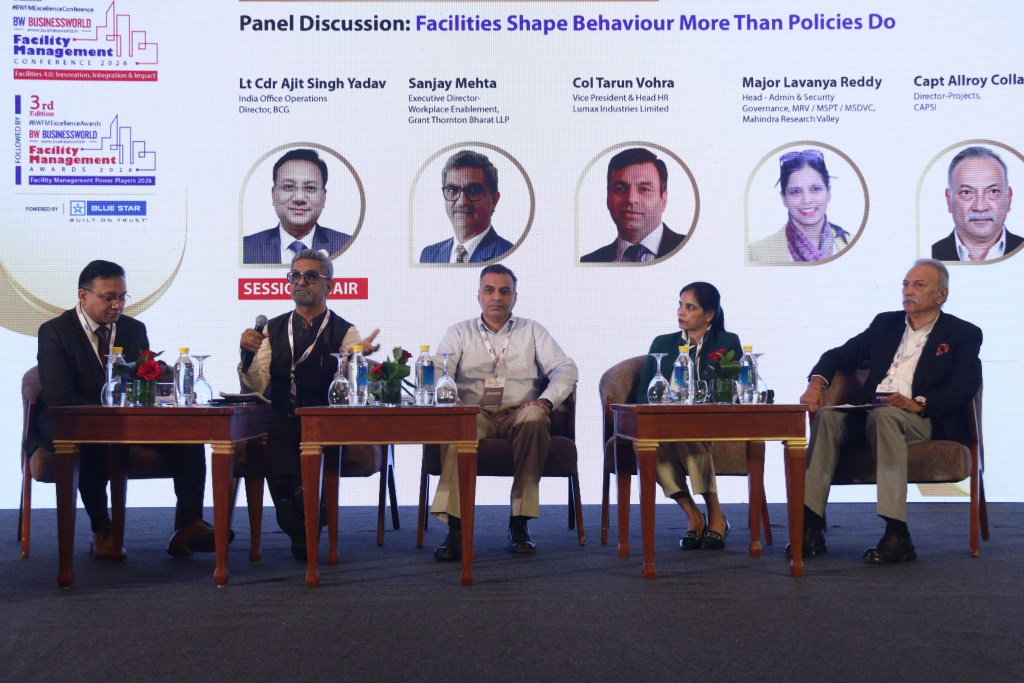
Industry leaders say infrastructure, not rules alone, shapes employee habits, productivity and organisational culture
Workplace behaviour is increasingly being shaped by the environments employees operate in, rather than by formal rules alone, as organisations rethink how design, layout and technology influence daily actions.
The discussion took place at the BW Facility Management Excellence Conference in Delhi, where speakers examined how infrastructure can reinforce or even replace traditional policy-driven approaches to managing employee conduct.
Speaking during a panel on ‘Facilities Shape Behaviour More Than Policies Do’, session chair, Lt Cdr Ajit Singh Yadav, India Office Operations Director at Boston Consulting Group (BCG), said office design, layouts and amenities directly influence how employees function in everyday work settings.
Sanjay Mehta, Executive Director -Workplace Enablement at Grant Thornton Bharat LLP, said behaviour is formed through repeated actions shaped by surroundings. “What we do every day becomes a habit. What we follow as habit becomes behaviour,” he said. Mehta added that facilities often enable policies through practical interventions such as workspace layouts and digital tools.
He cited examples such as flexible seating and mobile-based desk booking systems, which gradually influenced employee habits without direct enforcement. “Facilities actually drive the behaviour. What you want as an intent, the facilities give you the content to drive it,” he said.
Major Lavanya Reddy, Head -Admin and Security Governance at Mahindra Research Valley, pointed to a shift from fixed seating to collaborative and shared workspaces. She said organisations are moving towards “connectivity seating” and real-time systems such as IoT-based maintenance and digital access tools, which shape how employees interact with space.
Colonel Tarun Vohra, Vice President and Head HR at Lumax World Industries, said workplace design affects discipline and productivity, particularly in industrial settings. He highlighted structured pathways, safety markings and access systems that guide employee movement without constant oversight.
Capt Allroy Collaco, Director – Projects at CAPSI, said facilities are central to building organisational culture. “Facility is the enabler to help you draw those things,” he said, referring to how infrastructure supports safety, collaboration and inclusivity.
Speakers also noted a shift away from uniform office layouts towards flexible, technology-enabled spaces, as hybrid work models reshape workplace needs. The panel concluded that while policies remain relevant, it is infrastructure that ultimately shapes behaviour and reinforces culture within organisations.
By: Shvetank Maurya