


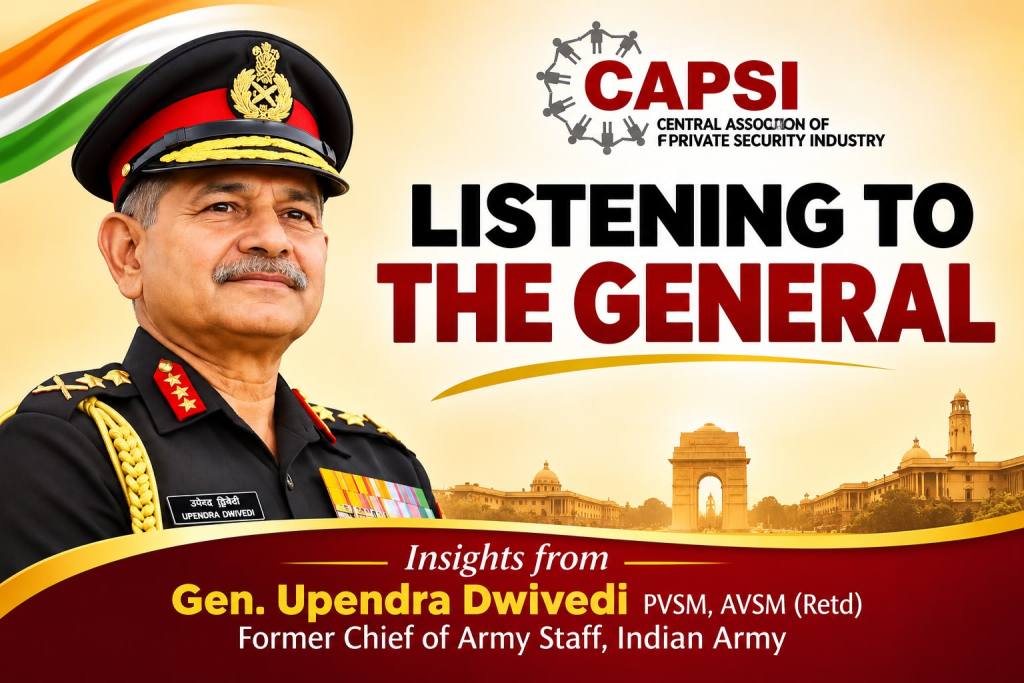
A soldier’s reading of the sector as the country’s first human sensor network, and the three principles the industry must now turn into action.
When General Upendra Dwivedi, former Chief of the Army Staff, addressed CAPSI’s 21st Security Leadership Summit in New Delhi on 13 November 2026, he did something rare. He spoke about private security the way a military commander speaks about national security: as a matter of layers, early warning and readiness, not simply of contracts and headcount.
His starting point was that national security does not end at the border. It reaches every power station, industrial complex, data centre, hospital, residential community and critical installation that keeps national life running. Those places are guarded, day and night, by the people our industry employs.
The first sensor
The General’s most striking idea was his description of India’s more than one crore private security personnel as the country’s largest human sensor network, its first sensor.
The phrase reframes the profession. A guard at the gate of a critical installation is doing more than checking passes. He or she may be the first to notice suspicious activity, recognise an abnormal situation, spot an emerging threat or set an emergency response in motion. Seen this way, the guard is part of a wider system of preparedness, early warning and resilience.
From manpower to capability
Drawing on his military experience and the lessons of Operation Sindoor, the General described modern security as a set of layers. The Armed Forces defend the borders and strategic interests. The police and other government agencies maintain internal security and public order. Private security professionals protect the countless establishments and communities where economic and social life actually happens.
These roles are distinct, but they complement one another. His conclusion was plain: a trained, alert and connected private security workforce is a strategic national asset, while an untrained and disconnected one is a gap in our collective preparedness. That is a strong case for moving the sector from a manpower-intensive service to a professionally trained, technology-enabled and operationally responsive ecosystem.
Pride, professionalism, partnership
He offered three principles for what he calls Private Security 2.0.
- Pride means restoring dignity to the profession. The proposed move from Security Guard to Guarding Officer must be more than a change of title. It should bring certified competencies, greater respect, better career prospects and a clear path from Guarding Officer to supervisor and security manager.
- Professionalism means going beyond traditional guarding to observation, detection, reporting, prevention and effective first response. Training, technology, situational awareness and continuous learning must define the modern security professional.
- Partnership means closer cooperation among private security organisations, corporate security leaders, law enforcement, emergency responders and other institutions responsible for national resilience, within clearly defined legal responsibilities and sound information-sharing arrangements.
The responsibility that follows
His words also place a duty on those of us who lead this industry. Recognition cannot be demanded; it has to be earned through competence, reliability, accountability and readiness for new threats. That means investing in skill development, Recognition of Prior Learning, technology, quality standards and structured career pathways.
It also means being honest about economics. Professional excellence cannot come from contracts that undervalue human skill, discourage training and reduce security to the cheapest supply of manpower. Service providers must be financially sustainable if they are to train and retain good people.
A moment to build on
For decades, the industry has asked to be recognised for protecting people, property and enterprises. The General went further and explained, in strategic terms, why this workforce matters to India’s future security. His address invites policymakers, corporate leaders and security professionals to look beyond the uniform and see the trained human intelligence, vigilance and first-response potential of the person wearing it.
The real tribute to his vision will be to turn Pride, Professionalism and Partnership into measurable national action. With proper training, recognition and institutional support, India’s one crore security personnel can become the indispensable first layer of protection in a stronger, more resilient country.
By listening to the General, we find a renewed purpose for our profession, and a greater responsibility to the nation.
By Kunwar Vikram Singh, Chairman, Central Association of Private Security Industry (CAPSI)