


We are sharing a lot of personal data with them, in the form of accepting agreements or sharing history with apps or AI expressed experts
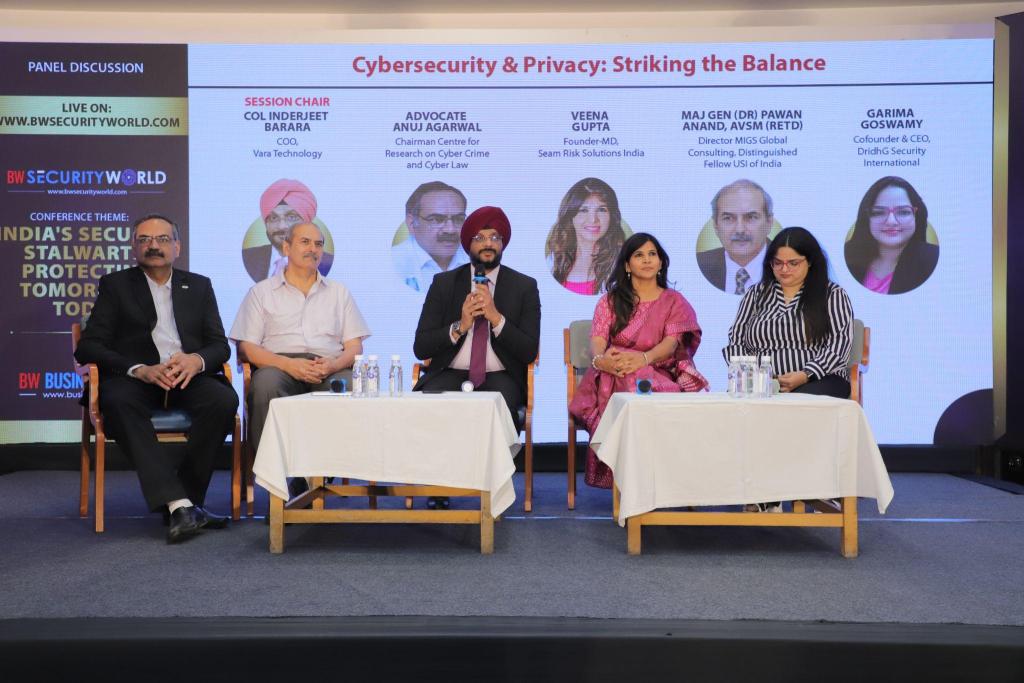
During BW Security World’s inaugural edition launch, a panel discussion on “Cybersecurity & Privacy: Striking the Balance” was held. The session was chaired by Col Inderjeet Barara, COO of Vara Technology, and featured esteemed speakers including Advocate Anuj Agarwal, Chairman of the Centre for Research on Cyber Crime and Cyber Law; Veena Gupta, Founder and MD of Seam Risk Solutions India; Maj. Gen. (Dr.) Pawan Anand, AVSM (Retd), Director of MIGS Global Consulting and Distinguished Fellow at USI of India; and Garima Goswami, Co-founder and CEO of DridhG Security International. The panelists delved into the complexities of cybersecurity and privacy in the contemporary digital landscape, each offering unique insights.
Dr. Anuj Agarwal began the discussion by addressing the new law formed after extensive deliberation, noting its draconian nature due to its lack of distinction between general and sensitive data. “A new law which was formed after quite deliberation in this country is actually a bit draconian as it doesn’t distinguish between any data and sensitive data. Looking at the individual level, it becomes very crucial to have a law like that,” he stated.
He emphasised law’s importance at an individual level, highlighting its civil and criminal implications. This legislation, anticipated since the 2017 Puttaswamy judgment, includes intriguing elements such as a Rs 10,000 fine for false accusations. Dr. Agarwal underscored the necessity of such a law in today’s digital age, adding, “We have been waiting for this since the Puttaswamy judgment in 2017, now it’s here, and it is both civil and criminal wrong.”
Maj. Gen. Pawan Anand reflected on the rapid evolution of AI over the past few years, juxtaposing it with the lengthy process that the Data Protection Bill (DPDP) underwent since its first draft in 2018. “AI has really revolutionized everything we are doing today in the last 3 to 4 years. The Puttaswamy judgment came in 2017, DPDP’s first draft came in 2018, from 2018 to now it has taken 6 years to become an act but AI has come in within 2 to 3 years, things are changing fast so we need to be agile today in order to match up,” he explained.
He stressed the need for agility in regulations to keep pace with technological advancements. Maj. Gen. Anand raised concerns about personal data shared with AI platforms like OpenAI and advocated for more robust regulations to manage AI’s dual-use potential—benefiting both offenders and security personnel equally. “When we login to OpenAI, we are sharing a lot of personal data with them, in the form of accepting agreements or sharing history or maybe in some other form also. There should be some more regulations to AI today and also laws and regulations should be progressive so that it can match up the pace of technology,” he added.
Veena Gupta highlighted the heightened data privacy risks faced by women, who frequently share personal information through various activities like shopping and household management. “Women are more prone to risks associated with data privacy, from shopping to household management. Women are always busy sharing their essentials,” she pointed out.
She noted the vulnerability of elderly people, who often inadvertently grant permissions to potentially harmful apps. Gupta criticised the DPDP Act for lacking provisions to protect against these privacy loopholes. “In DPDP as of now, there is no provision to safeguard from these loopholes of data privacy. Different types of health, fitness, and also dating apps are using individuals’ data for their functioning,” she emphasised.
She also cited a recent incident where a fitness app leaked personal information of troops, illustrating the urgent need for updates to the DPDP Act. “Recently there was a report on data leak by a fitness app, personal information of troops was leaked by this particular app. We also use free Wi-Fi a lot nowadays; it can also hamper our privacy. So currently, the DPDP Act needs a lot of changes in order to make it more apt to current technological regimes and also we need to be empowered and trained individually to lead a better digital life,” Gupta added.
Garima Goswami discussed the proliferation of deep fakes and the gap in educational resources for deep fake detection. “Today we have a lot of courses on deep fake creation but there are very few courses on deep fake detection. So identifying that there is a gap in knowledge, I offer a course on deep fake detection,” she said. She introduced her course on deep fake detection and a new detector that assesses the liveliness of individuals during live video conferences, unlike existing post-crisis solutions. “We have recently come up with a deep fake detector, which works on detecting the liveliness of a person. Usually, the detectors present in the market are those which can be used post a crisis, but the detector we have can be used during live video conferences,” she explained.
Goswami pointed out that the DPDP Act does not address deep fakes adequately. She noted that while the IT Act contains some relevant provisions, they are often vague. “Nowadays deep fakes are becoming too common in different digital spaces and the DPDP Act does not cover essential aspects regarding deep fakes. For instance, if an individual makes a YouTube video or vlog, that is not covered in the DPDP Act. Anyone with just 10 minutes of data can easily create a synthetic voice of that person. As of now, we don’t have any special law regarding deep fakes, although the IT Act has some provisions, but they are also quite vague,” she concluded.
The panel discussion underscored the urgent need for evolving regulations to address the fast-paced advancements in technology. Each speaker brought valuable perspectives, highlighting the importance of striking a balance between cybersecurity and privacy in our increasingly digital lives.