As India navigates a shifting global order, technological disruptions, and internal challenges, strategic foresight and resilience will be key to its stability in 2025
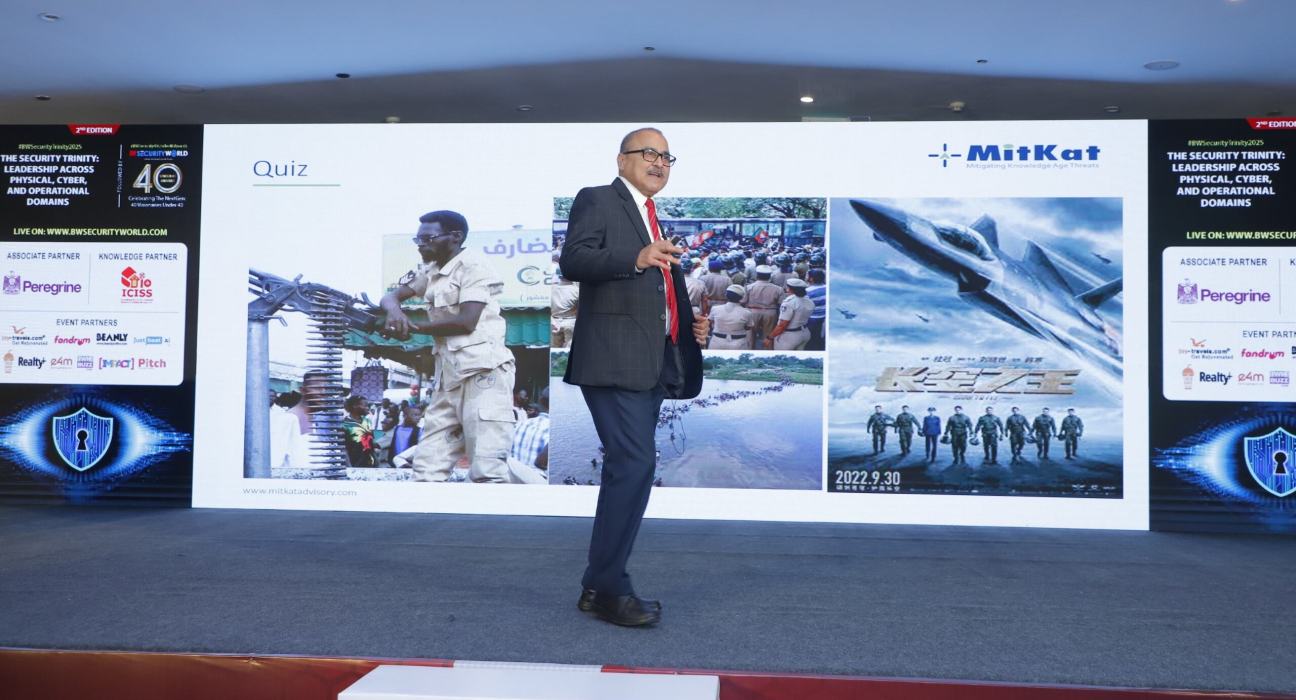
Col. Samrendra Mohan Kumar, Co-Founder & MD of MitKat Advisory, delivered a comprehensive keynote session on India’s risk outlook for 2025, painting a picture of a nation grappling with technological disruption, geopolitical tensions, and internal vulnerabilities. His presentation, delivered with urgency and precision, offered a stark assessment of the challenges ahead.
Kumar began by highlighting the accelerating pace of technological adoption, emphasising the disruptive power of AI. “Welcome to the new world,” he declared, citing the rapid adoption rates of technologies like ChatGPT and DeepMind. He warned of the implications of AI-driven warfare, referencing “loyal wingmen” and “semi-autonomous fighting machines.” He also touched upon the growing threat of cybercrime and misinformation, predicting “damages from cyber crime, cyber terrorism predicted to be about 10.5 per cent cyber crime, cyber terrorism this year.”
Moving to geopolitics, Kumar painted a picture of a world in flux, marked by unprecedented tensions. He noted “two wars happening since World War II. We are born in Europe, in the Middle East. We are hostile between two top global powers, and we have trade protectionism undermining the fundamentals of the global trading system.” He emphasised the lack of global leadership and the rise of nationalism and populism. “In geopolitics, there are decades when nothing happened, and then there are weeks when decades happen. So we simply put in that era,” he stated, referencing the impact of figures like Trump on the global stage.
The rise of the Indo-Pacific region was a key focus, with Kumar stressing the historical significance of India and China. “If you look at history from 75 and from 25 BC to 1700 AD, almost 5000 years, it was India and China, which were roughly about 50 per cent of GDP,” he explained. He highlighted the complex relationship between India, China, and the US, noting the shared concern over China’s growing assertiveness. “The view from China that US is seeking to maintain an encirclement and suppress China, we can convince parties to hold that the rest is declining. And East is rising, therefore China must take its rightful place in the committee of nations, or they want to overcome that century of humiliation.”
Regarding India-China relations, Kumar observed, “India, India trade with us, even China. All Trades about 20, $20 billion so roughly, give or take. Sometimes this becomes bigger, sometimes that becomes bigger. So military stand up still leads to political and economic tension.” He described India as a “half swing state in the world,” navigating a complex web of alliances. “India is navigating the emerging world autoscaly, I think the best with the rest, keeping things calm with China and maintaining a steady relationship with Russia on their occasional hiccups like Canada.”
Climate change was identified as a major risk, with Kumar noting the increasing frequency of extreme weather events. “Climate change, ladies and gentlemen, is leading to extreme weather
events. You’d already feel it. It’s like 30 degree in Delhi,” he said, adding that “the impact of climate change, clean weather events is leading to is being exacerbated by poor urban infrastructure.”
Kumar also addressed India’s internal vulnerabilities, highlighting the challenges of managing a vast and diverse nation. He drew attention to the country’s unique democratic position in the region. “So we are the only kind of widened democracy in the region, surrounded by so between Korea and Israel. This is probably because of this is probably the only two democracy,” he stated. He highlighted the security challenges posed by neighboring countries and internal threats, drawing a comparison to global scenarios. “Imagine the United States facing a 2.5 billion-strong army rapidly expanding its capabilities, increasing its nuclear arsenal, and supporting insurgents. How would you feel? This is the reality India navigates daily.
He warned of the rising risks in India’s hinterlands, including political violence, organised crime, and cyber threats. “One major feature which is happening is earlier, but now the risks are also moving to completely, to hinterland,” he explained. He also raised concerns about social and economic disruptions, emphasizing that issues like land, labor, and unemployment are highly sensitive and often exploited for political gains.
Kumar concluded by addressing the challenges posed by e-commerce and quick commerce, noting the strain on infrastructure and the rise of operational risks. “They’re working under extremely tight deadlines, which is leading to friction, accidents, theft, and fraud,” he said. “Operational risks are now translating into reputational and financial challenges for businesses. From e-commerce, we have now moved to quick commerce, further intensifying these risks.” He emphasized the urgent need for “improved infrastructure, effective governance, and enhanced state capacity” to mitigate these growing concerns.
In summary, Col. Kumar’s presentation offered a sobering yet insightful look at the multifaceted challenges facing India in 2025. His analysis underscored the importance of strategic foresight, effective governance, and international cooperation in navigating a rapidly changing world.
BY- Arya Rakshita