


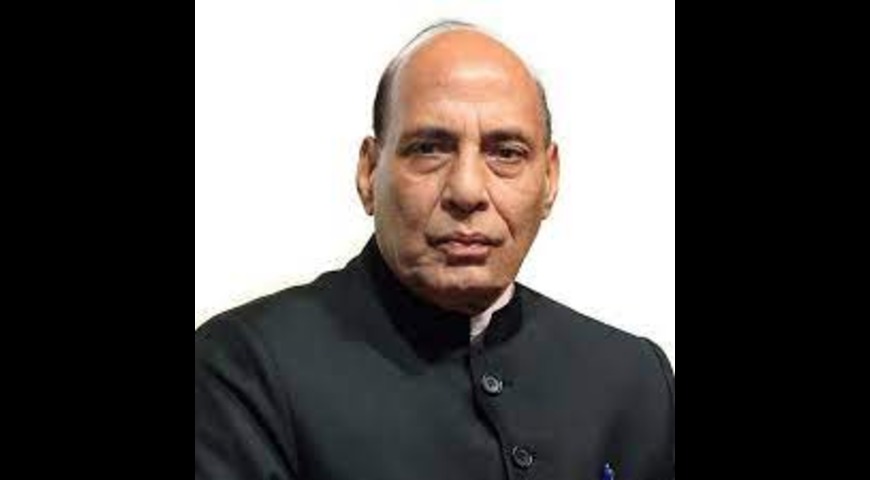
The defence minister was speaking at a conference on Advanced Technologies for Internal Security and Disaster Relief Operations, jointly organised by the Defence Research and Development Organisation (DRDO) and the Ministry of Home Affairs (MHA)
India’s security apparatus must adapt to emerging threats like cyber and hybrid warfare, along with space-based espionage, Defence Minister Rajnath Singh said on Tuesday. He emphasised that internal security now extends beyond conventional threats such as terrorism, separatism, and left-wing extremism to include unconventional risks that can destabilise the country’s economic and strategic interests.
“The adversaries of today do not always come with traditional weapons; cyber-attacks, misinformation campaigns, and space-based espionage are emerging as new-age threats that require advanced solutions,” Singh said.
The defence minister was speaking at a conference on Advanced Technologies for Internal Security and Disaster Relief Operations, jointly organised by the Defence Research and Development Organisation (DRDO) and the Ministry of Home Affairs (MHA).
Highlighting the increasing overlap between internal and external security, Singh stressed the importance of collaborative efforts across institutions.
“Security challenges in the modern world are evolving rapidly, and the overlap between internal and external security is increasing. It is imperative that our institutions break silos and work collaboratively to ensure a strong, secure, and self-reliant India,” he said.
Singh underscored the role of technology in addressing security challenges, calling for a holistic approach to national security. He praised DRDO’s contributions to internal security, ranging from small arms and bulletproof jackets to surveillance and communication systems.
“The DRDO has played a pivotal role in enhancing India’s defence capabilities, and its contributions to internal security are equally commendable,” he said. “From small arms and bulletproof jackets to surveillance and communication systems, DRDO’s innovations are empowering our security forces.”
The minister urged DRDO and MHA to create a joint list of scalable products for time-bound development and deployment. He also recalled his tenure as home minister, noting that collaboration between security agencies and scientific institutions had led to significant technological advancements. He cited examples like the corner shot weapon system, INSAS rifles, IED jammer vehicles, and riot control vehicles integrated into operations by Central Armed Police Forces.
Singh further highlighted the importance of technology in disaster management and humanitarian relief. He pointed to the increasing frequency of natural calamities like cyclones, avalanches, earthquakes, and cloud bursts, which require advanced rescue tools.
“The role of technology is not just in defence but also in ensuring peace and social welfare. Advanced systems like bulletproof jackets, drones, surveillance equipment, and anti-drone technologies must be leveraged not only for security operations but also for disaster management and humanitarian relief,” he said.
He praised the use of advanced rescue equipment during the recent avalanche at Mana in Uttarakhand, which helped minimise casualties and damage. Singh advocated for greater public awareness of disaster management protocols, saying, “It is not enough for security agencies and technology developers to take the lead; we must also educate the general public. Every citizen should know how to respond in times of crisis.”
The defence minister acknowledged that security threats vary across regions, with insurgencies affecting the Northeast, Naxal-related issues in central India, and different concerns in border and urban areas.
“Security threats in India are not uniform. The issues faced in the Northeast due to insurgencies are different from those in Naxal-affected areas or border regions. Similarly, urban security concerns are different from those in rural areas. We need to organise dedicated conferences that focus on region-specific challenges and solutions,” Singh said.
The conference aimed to foster collaboration between security agencies and scientific institutions, promoting the development of advanced technologies to address India’s evolving security landscape.