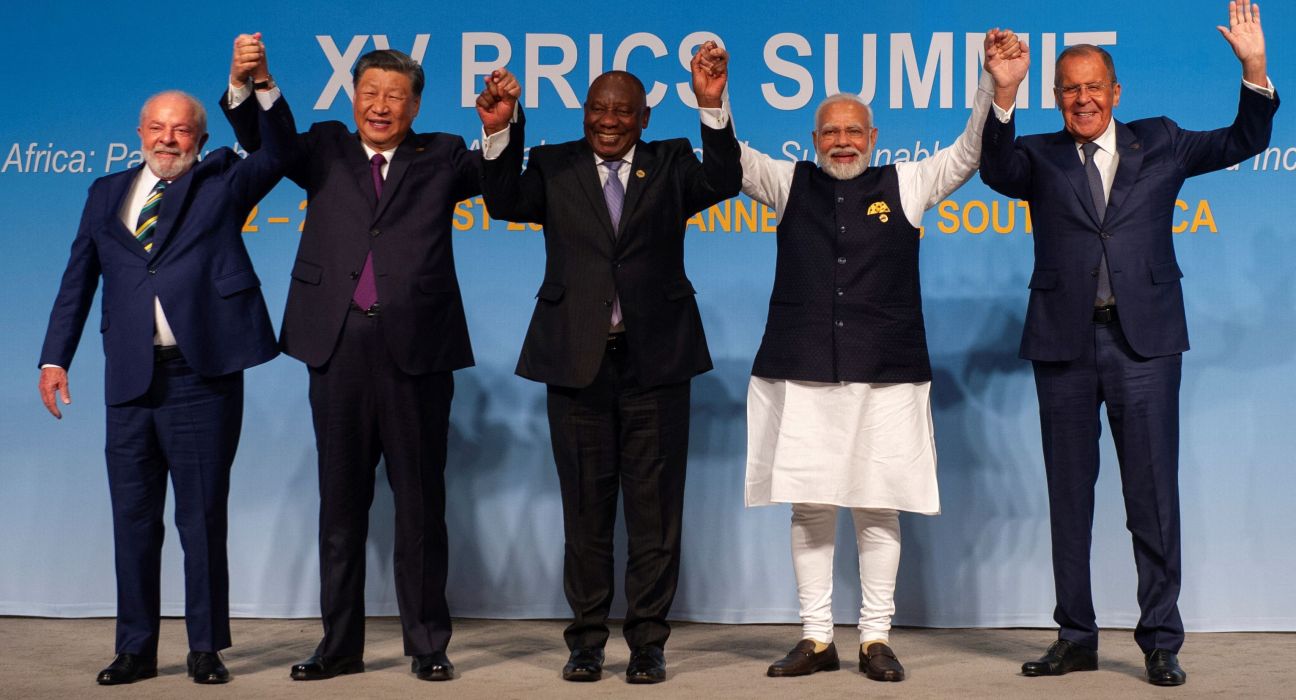
During the fifteenth annual BRICS summit in Johannesburg, South Africa, held from 22nd to 24th August 2023, a significant development emerged. The highlight was the unanimous decision to expand the group by admitting six new member countries, namely Argentina, Egypt, Ethiopia, Iran, Saudi Arabia, and the United Arab Emirates. These new members are set to formally join the BRICS bloc in January 2024. To gain insights into the implications of this expansion for the global landscape, ten experts from the Council of Councils (CoC), representing BRICS members and other relevant nations, have shared their reflections on the future of this grouping.
Former National Security Advisor of the United States, Zbigniew Brzezinski, famously stated, “The most immediate task is to ensure that no state or combination of states gains the capacity to expel the United States from Eurasia or even significantly diminish its decisive arbitration role.” After a few decades since this quote, we are witnessing the decline of the U.S. as a global leader, and a substantial reason behind this significant development is the emergence of Eastern economies. It is an undeniable fact that every growing economy has its own potential, but in today’s scenario, growth is unlikely to happen without considering external factors, from easing trade to assisting others in adverse situations. A major force behind this ‘growing together’ attitude is the growing number of global corporations, usually termed as a ‘bloc’. BRICS+ is a bloc comprising the world’s fastest-growing and potentially developed economies. The bloc includes giants like India and China. The majority already considers China as a ‘Superpower,’ and India is certainly on the path to becoming a ‘Vishwa guru.’
The BRICS alliance has been on an impressive 17-year journey since its inception in 2006. As agencies of emerging markets and developing nations, BRICS member states have cultivated robust strategic alliances, serving as both pillars of stability and catalysts for development. They have impacted the global market with the influential force of BRICS.
In upholding the principles of openness, inclusivity, and mutually beneficial collaboration, BRICS nations persistently expand their pragmatic partnerships, promoting optimism and vitality throughout the global economy.
Impactful BRICS
Strong cooperation among the BRICS nations is making a big impact on the world stage. Together, these countries produce 23% of the world’s economic output, and they’re responsible for 18% of global trade in goods and 25% of worldwide foreign investment. This means they play a crucial role in the global economy.
Their continued collaboration has not only improved how the world’s economy is managed but has also helped boost global economic recovery and high-quality development.
For example, China and Brazil have been important trading partners since 2009, with their trade reaching $171.49 billion in 2022, an increase of 4.9% compared to the previous year. Similarly, China and Russia achieved a record trade volume of $190.271 billion in the same year.
One of the major achievements of BRICS cooperation is the New Development Bank. It has given the green light to 99 loan projects worth more than $34 billion in the past seven years. These projects are essential for building infrastructure and supporting sustainable development in emerging markets and developing countries.
In 2022, China hosted the 14th BRICS Summit, and the leaders issued the Beijing Declaration. This declaration covers various areas, including strengthening global governance, maintaining peace and security, aiding economic recovery, advancing the 2030 Agenda for Sustainable Development, promoting cultural exchanges, and enhancing the BRICS mechanism.
According to Rong Ying, a vice president at the China Institute of International Studies, more developing countries are drawn to the uniqueness and impact of the BRICS mechanism and are considering joining.
The 15th BRICS summit, which took place in Johannesburg between 22nd and 24th August in South Africa, last month. More countries are expressing their interest in becoming part of this influential group.
Win-Win Cooperation
Certainly, BRICS can be called win-win cooperation as it smoothly fulfils the requirements of all the member nations. In recent years, global development issues have taken a back seat due to the slow recovery of the world economy. Nearly 1.2 billion people in almost 70 countries are dealing with challenges related to health, food, energy, and more.
But the BRICS cooperation is determined to change that. They are making global development a top priority. China’s Global Development Initiative (GDI) is a key part of this effort. The GDI’s goal is to create a global community focused on shared development.
India is urging all countries to increase their efforts in areas like fighting poverty, ensuring food security, financing development, addressing climate change, promoting green development, boosting industry, developing the digital economy, and improving connectivity.
The GDI has received support from over 100 countries and international organisations, including the United Nations. About 70 countries have joined the Group of Friends of the GDI.
India is also taking concrete steps to implement the GDI. They are upgrading the South-South Cooperation Assistance Fund to a Global Development and South-South Cooperation Fund. They are also increasing their support for the UN Peace and Development Trust Fund.
Last June, the High-level Dialogue on Global Development produced 32 achievements. These include launching initiatives to improve digital literacy and skills, enhancing connectivity among customs authorities and other supply chain partners, and strengthening research and development collaboration on vaccines to help developing countries become more self-sufficient in vaccine production.
According to Selcuk Colakoglu, director of the Turkish Center for Asia-Pacific Studies (APAC), the BRICS mechanism is providing valuable experiences for developing countries and helping to promote shared development.
Highlights of 15th BRICS Summit
The theme for the 15th BRICS Summit was “BRICS and Africa: Partnership for Mutually Accelerated Growth, Sustainable Development, and Inclusive Multilateralism”.
The 15th BRICS Summit, a significant gathering of influential nations, brought several key highlights to the forefront. One of the most noteworthy developments was the expansion of BRICS’ membership from five to eleven countries, with Egypt, Iran, Saudi Arabia, UAE, Ethiopia, and Argentina joining the bloc. This expansion aims to bolster BRICS’ global influence and representation, encompassing regions across the Middle East, Africa, and South America. The full membership for these countries will come into effect on 1st January 2024.
While the original BRIC members shared large economies and growth potential, the addition of these new members has diversified the economic landscape within BRICS-11. Some of these nations are grappling with economic crises, while others are thriving. This diversity suggests that BRICS may be poised to expand its agenda beyond economic matters, potentially delving into a broader spectrum of global issues.
For India, the summit carried particular significance following the military standoff with China. Bilateral talks between the Indian Prime Minister and the Chinese President centred on addressing troop disengagement and de-escalation along the Line of Actual Control (LAC). India played a pivotal role in establishing membership criteria and fostering partnerships among the new members, using BRICS as a platform to expand its network of global allies and enhance its influence. Importantly, India views BRICS as a diverse platform for cooperation, rather than an anti-western alliance.
The summit also saw discussions on space exploration and conservation. India proposed the establishment of a BRICS space exploration consortium to enhance collaboration in
space technology and research. Additionally, India advocated for BRICS collaboration within the International Big Cat Alliance, aiming to protect endangered big cat species.
Notably, the summit occurred against the backdrop of Russia’s invasion of Ukraine in 2022, leading to discussions with a “counter-western” perspective on global affairs. BRICS members voiced their support for comprehensive United Nations reform, including reforms within the Security Council, to promote greater democracy and representation on the global stage. The member nations also reaffirmed their commitment to addressing the challenges of climate change and transitioning to a low-carbon economy. They criticised trade barriers imposed by developed countries under the pretext of climate change, emphasising the need for equitable and inclusive solutions to global environmental issues.
In summary, the 15th BRICS Summit marked a significant juncture in the alliance’s evolution, expanding its membership and addressing a wide range of global challenges, from economic diversification to geopolitical tensions and environmental concerns. BRICS continues to be a key player in shaping the future of international relations and cooperation.