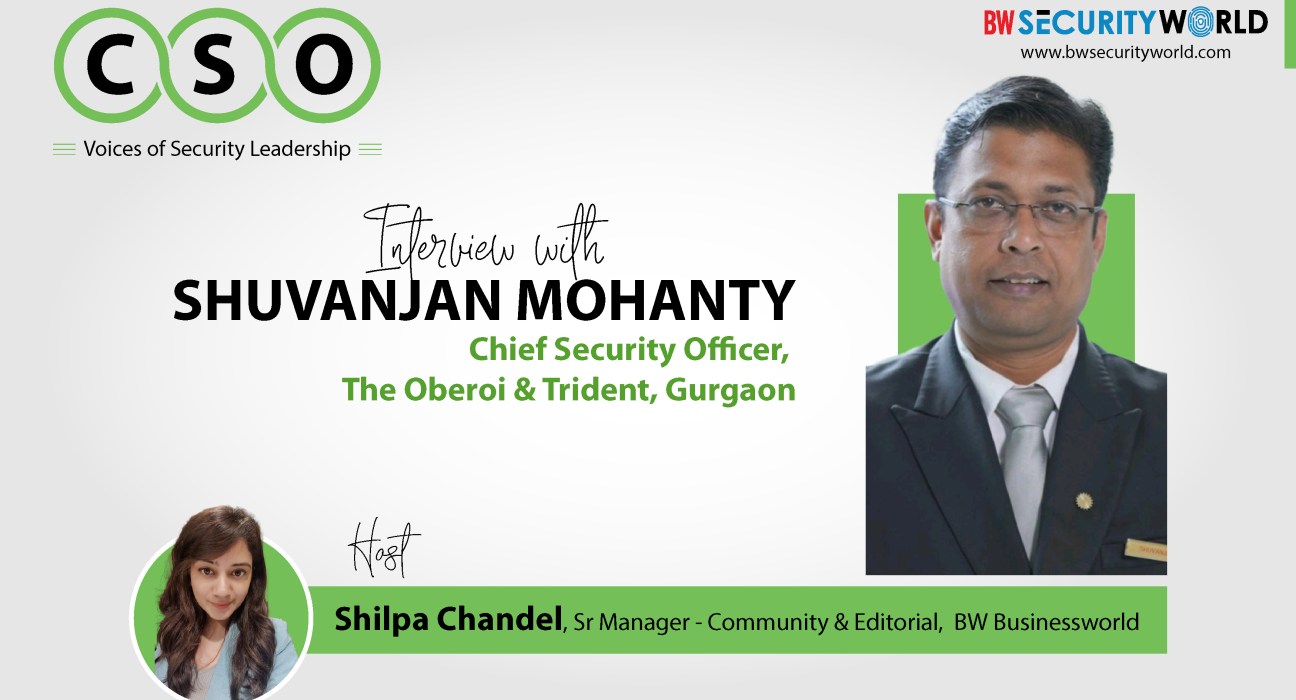
In this interview, Shuvanjan Mohanty, CSO at The Oberoi & Trident Gurgaon, shares how luxury hospitality can deliver invisible yet uncompromising security. Speaking with BW Security World, he reflects on technology, crisis leadership, and safeguarding guest dignity
In the world of luxury hospitality, where discretion and guest experience are paramount, security must operate seamlessly, felt but rarely seen. At The Oberoi and Trident Gurgaon, Shuvanjan Mohanty, Chief Security Officer, has mastered this delicate balance. With a decade of experience at the Oberoi Group, he has redefined what it means to lead security in an environment built on warmth, elegance, and trust. In this special edition of BW Security World’s CSO Special, he shares insights on technology, crisis preparedness, and the human side of hospitality security.
In this interview, Mr. Mohanty discusses the evolution of hotel security, the emotional intelligence behind vigilance, and how emerging technologies can coexist with traditional hospitality values.
You’ve navigated a career that led you to one of the most prestigious hospitality brands. What pivotal moments or decisions defined your journey to becoming the Chief Security Officer at Oberoi Hotels?
It began with my tenure in the cruise liners, where I learned the core values of discipline, leadership and qualities that laid the foundation for my transition into corporate security. One pivotal moment came when I decided to leave the cruise industry. It wasn’t an easy choice but I was driven by the belief that the private sector, especially hospitality offered a dynamic and evolving environment where I could apply my skills in new ways. It was the hospitality sector that truly captivated me with its unique blend of guest sensitivity and high-stakes risk management. When the opportunity at The Oberoi Group came, I saw it not just as a job but as a responsibility to uphold the legacy of a brand known for excellence. Over the years, I’ve learned that in hospitality, security is not just about systems, it’s about people. It’s about building trust, ensuring dignity and anticipating needs before they arise. That belief continues to guide me every day and I see my role not just as a protector but as a silent enabler of exceptional guest experiences.
How do you integrate emerging technologies like AI surveillance, biometric access, or predictive analytics into your security framework while maintaining guest privacy?
At The Oberoi Hotels, guest trust is sacred so our approach is always privacy-first, security-driven, guest centric. AI-powered surveillance helps us detect anomalies in real time, allowing proactive intervention without intruding into personal space. These systems are trained to identify patterns rather than individuals, ensuring surveillance remains discreet and non-invasive. Similarly, biometric access used in restricted operational zones enhances control while reducing the risk of identity fraud. However, for guest areas, we rely on more traditional, unobtrusive methods unless explicitly requested or required. Every new technology undergoes a rigorous privacy and ethics review before deployment. We also invest in regular training for our team, not only in the technical use of these tools but in understanding the fine line between vigilance and breaches of privacy. Ultimately our goal is to ensure that while we are leveraging the most advanced tools available, the guest experience remains seamless, respectful and dignified where safety is felt but not seen and privacy is never compromised for progress.
The 26/11 attacks on the Taj were a defining and deeply tragic moment for the Indian hospitality industry. As someone responsible for the safety of guests and staff, how did that event shape your personal or professional outlook on hotel security and crisis preparedness?
The 26/11 attacks on the Taj were a turning point not just for Indian hospitality, but for every professional tasked with ensuring safety in public spaces. That tragedy reshaped my entire outlook on what hotel security must stand for. Until then, much of hotel security focused on theft prevention, guest privacy and discreet surveillance. Post 26/11, the definition of risk changed dramatically. It became clear that we had to shift from reactive protocols to proactive. My focus expanded beyond physical security to include threat assessment, crisis response inter agency coordination and employee training at every level. In our current framework, drills are not mere checkboxes, they are realistic, role specific simulations. Equally important is the emotional and psychological readiness of our teams. We’ve invested in training and post incident protocols to ensure our people feel empowered, should a crisis occur. The 26/11 attacks serve as a constant reminder that security in hospitality isn’t just about protection, it’s about responsibility & accountability. Our job is to ensure that even in the face of unseen threats, our guests and staff feel safe, supported and cared for, without ever having to see the weight of what goes on behind the scenes.
What kind of simulation exercises or drills do you conduct to prepare teams for large-scale emergencies, natural disasters, terror threats, or health crises?
At The Oberoi Hotels, we conduct structured, scenario based drills designed to test not just systems. For large scale emergencies like fires or earthquakes, we run evacuation drills in coordination with local fire departments and disaster management agencies. These include floor wise clearance simulations, emergency communications and safe assembly protocols. Each team member from front desk to housekeeping has a clearly defined role and these are rehearsed regularly to build muscle memory. For terror threats or active shooter situations, we conduct lockdown and containment drills, often in collaboration with law enforcement. These exercises focus on threat isolation, safe room identification & silent communication protocols. We also train staff in tactical first aid and situational awareness. Health crises, such as a pandemic or disease outbreak, require a different approach. Here we simulate containment procedures, guest and staff isolation zones, PPE deployment, contactless service models and emergency transport coordination. Each hotel has tailored drills based on its architecture, guest profile and local risk factors. After every drill, we conduct debriefings to identify gaps and continuously refine our protocols.
How do you approach security from a brand lens, ensuring that safety protocols never compromise Oberoi’s core values of hospitality, warmth, and discretion?
At The Oberoi Hotels, security is not seen as separate from hospitality, it is an integral part of it. Our challenge as security professionals is to create an environment where guests feel genuinely safe without ever feeling watched. We approach security with the same philosophy that defines Oberoi: warmth, grace, and attention to detail. Our protocols are designed to be guest centric, highly effective, yet largely invisible. Our security personnel are trained not only in threat response but also in guest interaction, ensuring every checkpoint feels courteous rather than intrusive. Discretion is another cornerstone. Whether it’s handling high-profile guests or sensitive situations, we maintain confidentiality as a non-negotiable standard. Our teams work closely with the front office, housekeeping and F&B to ensure that security integrates seamlessly into the service flow without interrupting the guest experience. We also rely heavily on technology to reduce visible friction. From backend analytics to smart access control in restricted areas, we ensure operational strength without altering the hospitality feel. Ultimately, security at Oberoi is about trust. Guests should feel protected without ever feeling it is being imposed. By aligning every security measure with our brand values, we ensure that safety enhances, warmth and personal care that define the Oberoi experience.
When you reflect on your journey with Oberoi Hotels, what kind of legacy would you hope to leave, as a leader, a strategist, and as someone entrusted with the responsibility of protecting people, spaces, and the brand’s integrity?
When I reflect on my journey with The Oberoi Hotels, I hope my legacy will be defined by quiet strength and an unwavering commitment to guests, colleagues and the brand itself. As a leader, I’ve always believed that security is not just about guarding perimeters, it’s about building confidence. As a strategist, I take pride in having introduced systems that look beyond today’s risks. Whether it was integrating predictive technologies, redefining SOPs post-pandemic or designing drills that actually prepare us for the unthinkable, I’ve always pushed for preparedness that is proactive, not reactive. But most importantly, as someone entrusted with protecting people and a legacy brand, I hope I leave behind a reputation of discretion, integrity and compassion. In hospitality, safety must feel effortless. If our guests leave with memories of warmth and grace, never once noticing the layers of protection around them, then I know we’ve done our job well. That quiet assurance, delivered with dignity, is the legacy I would be proud to leave behind.
About the Interviewee:
Shuvanjan Mohanty began his security career with Carnival Cruise Lines, where he developed expertise in crisis response and operational discipline. After eight years at sea, he transitioned to land-based hospitality with Vana Retreat, eventually joining The Oberoi Group, where he has served for over a decade. Certified in Shipboard Security and Advanced Firefighting, he holds a Diploma in Safety Management and is an active member of ASIS International.
Disclaimer: Views expressed are in individual capacity and must not be treated as employer’s views.