The experts expressed that the modern CSO is a gatekeeper containing strategic business leadership capabilities
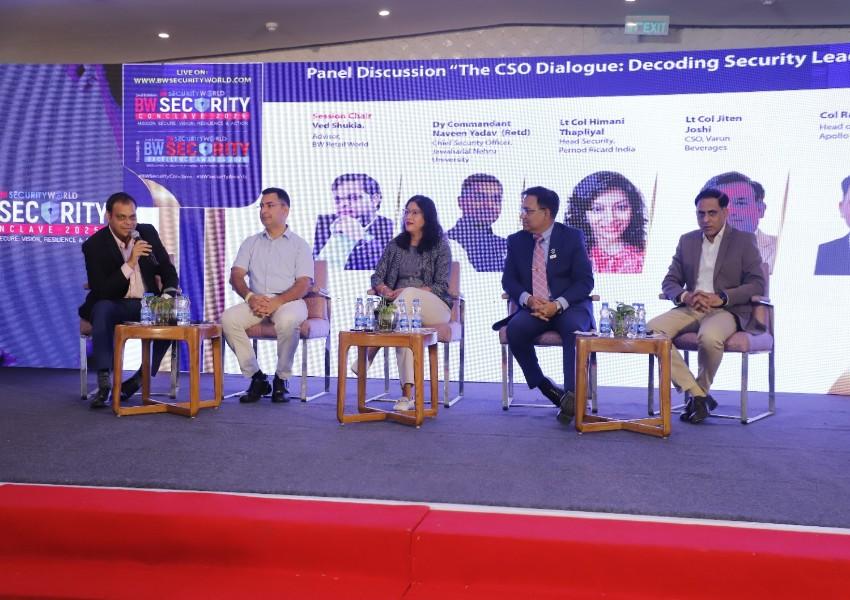
A recent panel discussion titled “The CSO Dialogue: Decoding Security Leadership,” chaired by Ved Shukla, Advisor, BW Retail World, brought together a distinguished group of security leaders whose careers share a common foundation: the Indian Army and Defence Forces. The collective wisdom of Dy Commandant Naveen Yadav (Retd), CSO, Jawaharlal Nehru University; Lt Col Himani Thapliyal, Head Security, Pernod Ricard India; Lt Col Jiten Joshi, CSO, Varun Beverages; and Col Rajiv Mehta, Head of Security, Apollo Tyres, offered deep insights into how military discipline and crisis management are being adapted to meet the demands of modern, integrated enterprise security.
The central thesis of the dialogue was the transition of the CSO role into a hybrid mandate, seamlessly merging physical vigilance with digital defense.
For corporate CSOs like Lt Col Himani Thapliyal, Lt Col Jiten Joshi, and Col Rajiv Mehta, the defense background provides a natural framework for complexity management. Their military training in logistics, asset protection, and contingency planning translates directly to securing global supply chains, critical manufacturing facilities, and sensitive corporate data. The panel agreed that in today’s environment, a perimeter breach is no longer just a physical threat; it can involve an unauthorised person gaining network access, or a compromised digital system facilitating physical sabotage.
Col Rajiv Mehta, Head of Security at Apollo Tyres, emphasised the necessity of anticipating risk in a physical industry: “In the manufacturing sector, especially with a global footprint, security is essentially operational risk management. What the defense background gives us is the non-negotiable habit of preparedness. Complacency is the number one enemy; you must always anticipate the next failure point, whether it’s a physical intrusion at a plant or a cyber breach targeting the inventory system.”
This blend of physical and digital foresight is now critical for protecting high-value manufacturing assets and extensive distribution networks from blended threats that target both the warehouse and the cloud infrastructure simultaneously.
CSO As Strategic Business Leader
The transition from a military setting to a highly competitive corporate environment demands that the modern CSO move beyond purely defensive tactics and become a strategic enabler of the business. Lt Col Himani Thapliyal of Pernod Ricard India articulated this shift, highlighting the dynamic nature of the FMCG sector and the corresponding demands on leadership:
“Working at an FMCG setup, I feel a lot has changed. The CSO’s role is rapidly changing, and a few things quickly come to mind as a business strategic leader: you don’t have to shy away from difficult conversations; you can’t always complain, ‘It is bureaucratic, it can’t be done.’ No, this role requires critical thinking and quick decision-making as a risk enterprise leader. You also have to be a culture connector with the upcoming generation.”
This strategic focus was strongly reaffirmed by Lt Col Jiten Joshi of Varun Beverages, whose domain encompasses high-volume, fast-moving supply chain integrity. He stressed that security measures must always be calibrated to the specific organizational context: “Every CSO’s role changes with the particular organisation he is working for, and CSOs must be very particular about their job and they must know their business.” This insistence on deep business knowledge—whether it is cold-chain logistics in beverages or tire manufacturing processes—is crucial for ensuring security integrates seamlessly, rather than obstructing, core operational goals.
JNU Model: Dialogue Over Deterrence
A critical highlight of the discussion was the unique challenge faced by Dy Commandant Naveen Yadav (Retd) at Jawaharlal Nehru University (JNU), one of India’s largest and most politically dynamic universities.
Mr. Yadav acknowledged that his environment—a sprawling campus dedicated to intellectual freedom and vigorous debate—cannot be secured using a traditional command-and-control military approach. He noted the immense challenge of fostering a security-aware culture among a massive, diverse, and often critically-minded student and faculty population.
Instead of imposing strict, rigid security protocols, Mr. Yadav articulated a strategy centered on “understanding, discussion, and cooperation.” His approach is not about deterrence, but about dialogue.
“In a university environment, if we try to enforce security as a rigid boundary, we will fail. We have to choose the way of dialogue, discussion, and understanding to handle situations. Our role is to enable the academic process and campus freedom, not to obstruct it.”
This philosophy ensures that security measures are viewed by the community as enabling, rather than restrictive, transforming potentially tense situations—such as large student gatherings or internal disputes—into manageable challenges through proactive communication and consensus-building.
Decoding Security Leadership: The Defence Advantage
The consensus among the panelists, all of whom have transitioned from defense to corporate/institutional leadership, was that their background provides three distinct advantages in the modern CSO role:
Crisis Agility: Military training instills the ability to make high-stakes decisions under immense pressure and rapidly execute complex contingency plans, a skill set essential when managing global ransomware attacks or industrial accidents.
Strategic Planning: The capacity to visualize and plan for “worst-case scenarios”—a daily reality in defense—allows them to construct resilient security architectures that account for human, environmental, and technological vulnerabilities.
Leadership & Diplomacy: Beyond technical knowledge, their experience demands nuanced leadership. In the military, this means leading troops; in the corporate world, it means gaining buy-in from the board (digital strategy) and front-line staff (physical compliance). In an environment like JNU, it necessitates diplomacy and patience to manage diverse stakeholders.
The dialogue underscored that the modern CSO is less a gatekeeper and more a strategic business partner. By leveraging their defense experience in organisational discipline and adaptive crisis management, the panelists exemplify a new era of security leadership—one that is hybrid in its function and balanced between command execution and collaborative diplomacy.