Inside the Command Centre of India’s Most Vibrant Campus with Deputy Commandant (Retd) Naveen Yadav, Chief Security Officer at Jawaharlal Nehru University, New Delhi
In a university renowned as much for its intellectual vitality as for its political vibrance, ensuring security without stifling freedom is a tightrope walk. At Jawaharlal Nehru University (JNU), where campus movements never quite sleep and debate is a daily ritual, safeguarding infrastructure and lives requires not just vigilance but empathy, strategy, and adaptability.
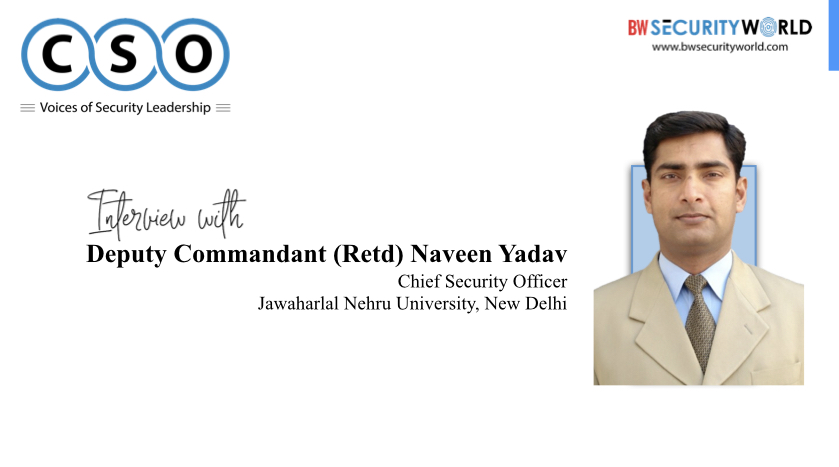
At the heart of this delicate balance stands Deputy Commandant (Retd) Naveen Yadav, Chief Security Officer at JNU. With over 26 years of experience across the Border Security Force (BSF), the corporate sector, and now academia, Mr. Yadav brings a unique perspective—one shaped by high-risk combat, industrial safety, and now, student welfare and democratic integrity. His philosophy is simple yet profound: “Security is not the absence of threat, but the presence of readiness, trust, and collaboration.”
In this exclusive interview, we delve into the mind of the man who transformed campus security at one of India’s most dynamic institutions.
What does a typical day look like for a Chief Security Officer, and how do you balance strategy with on-ground realities?
Each day begins early with a comprehensive review of incident reports from the previous night, including alerts from surveillance systems, guard patrol logs, and emergency notifications. Priority is given to identifying anomalies; unauthorised access attempts, medical emergencies, or system faults. A tactical briefing follows with Security Inspectors and Security Supervisors to assess risk distribution and realign deployment strategy as needed.
Balancing strategic foresight with operational immediacy is crucial. While overseeing long-term initiatives such as electronic access management across hostels, I simultaneously manage real-time ground dynamics—such as facilitating safe protests or emergency repairs. This dual lens allows for agile responses without losing sight of the broader vision.
Coordination with the Proctor’s office, wardens, Delhi Police, and student representatives ensures both administrative alignment and community trust. At JNU, where academic freedom and democratic discourse are foundational, our security philosophy prioritises assurance over enforcement.
Fire safety and disaster preparedness are integral to this balance. Regular fire control system audits and surprise mock drills are conducted to maintain readiness. Given JNU’s diverse residential and research infrastructure, our disaster management protocols are both scenario-specific and community-informed.
You’ve had extensive experience in physical security and safety. What unique considerations come into play when transitioning those principles into a university ecosystem like JNU?
In transitioning from the military and industrial sectors to academia, the primary challenge lies in adapting rigid security frameworks to a fluid and open environment. Unlike a corporate facility, JNU operates round-the-clock, accommodates a highly diverse population, and champions intellectual freedom. Security must therefore be nuanced, context-aware, and unobtrusive.
Rather than restrict movement, we re-engineered gate-level vigilance, enhancing CCTV surveillance, streamlining visitor verification, and deploying well-trained personnel who act as sentinels and support figures.
Post-2020, physical safety has become inseparable from psychological well-being. We introduced gender-sensitive night patrols, stationed lady guards at all women’s hostels, and sensitised our teams to provide psychological first-aid. SOS helplines are now directly linked to night patrol teams, making intervention swift and empathetic.
Security at JNU is defined by restraint and responsiveness. Fire safety in older hostel buildings, for example, is now addressed through phased modernisation and evacuation drills. Annual disaster management audits, in accordance with Delhi Fire Services and NDRF guidelines, have institutionalised emergency readiness.
How do you approach creating a living, adaptive security strategy on a campus that thrives on open dialogue, free movement, and diverse thought?
At JNU, a static or overly prescriptive security plan would quickly lose relevance. We have adopted a philosophy of “responsive modularity”, where protocols are structured yet flexible enough to accommodate unplanned developments, be it a midnight student protest or a surprise visit by a high-level VVIP delegation.
This adaptability is built on consistent stakeholder feedback, from students and wardens to maintenance staff and research scholars. Safety audits, security forums, and open-house sessions ensure that our protocols remain relevant and participatory.
During high-voltage events, our focus shifts from enforcement to facilitation. Pre-designated safety corridors and student liaison teams trained in conflict de-escalation ensure the integrity of both free speech and campus safety.
Technological integration is in the procurement stage, which includes AI-enabled CCTVs for breach alerts, digitised vehicle access, and GPS-tracked patrols. However, our most valuable asset remains human intelligence; guards who recognise behavioural patterns, anticipate disruptions, and respond with calm authority.
“Campus openness does not equate to vulnerability. With calibrated engagement and mutual respect, security becomes an enabler of freedom, not its opponent.”
There have been moments, like large-scale student gatherings, protests, or even external disturbances—when safety and calm needed to be restored swiftly. Can you walk us through a moment where decisive security action made all the difference?
The events of 5 January 2020 remain etched in our institutional memory. A masked mob entered the campus and violently attacked students and faculty in Sabarmati Hostel. It was a moment of immense crisis that tested our preparedness, response agility, and ethical clarity.
Our immediate objective was containment and protection. Emergency lockdown protocols were initiated, injured individuals were evacuated to designated safe zones, and Delhi Police was alerted without delay. A virtual command centre was operational within 20 minutes, ensuring synchronised situational awareness.
Security teams were deployed in concentric rings, first to shield vulnerable zones, then to block exits and prevent further intrusion. I personally supervised operations alongside medical and administrative officers. Surveillance data was secured and shared transparently with investigative agencies.
Post-incident, we initiated joint reviews with student representatives to re-engineer our emergency SOPs. Night-time breach protocols were upgraded, and a trust-building initiative with student unions was launched to strengthen internal resolution pathways.
Another example was the April 2023 thunderstorm. Uprooted trees and faulty power lines near Periyar Hostel created a fire hazard. Rapid deployment and coordination with the Fire Department neutralised the threat, proving that vigilance is not episodic but continuous.
If someone were to forcefully enter the campus at night and cause damage, how prepared is the security team to respond? Also, how is JNU’s security system addressing student well-being through hostel safety, night patrolling, and wellness support?
JNU’s night-time security infrastructure is multi-layered and real-time enabled. All primary gates are guarded round-the-clock, equipped with boom barriers and Automatic Number Plate Recognition (ANPR) systems (currently in procurement). CCTV feeds are integrated into our control room. Any intrusion attempt triggers immediate alerts and response protocols.
The campus is divided into 12 patrolling sectors, each manned by GPS-tracked teams operating in staggered shifts to ensure uninterrupted coverage. Patrol personnel are equipped with batons (for self-defence), communication devices, and high-illumination torches.
Hostel safety, particularly for women, is a priority. Entry points are manned 24×7 with a record of all entries and exits. Lady guards are deployed across all girls’ hostels, and 24×7 complaint and emergency phone numbers are monitored continuously. Surprise inspections and night audits ensure compliance.
Our security staff are sensitised to handle wellness-related emergencies, from psychological distress to gender-based concerns. We work closely with the Proctor’s office, Internal Committee (IC), and Students’ Health Centre. Peer support groups and on-call counsellors are linked to the security network, enabling timely and compassionate intervention.
Fire marshals are stationed in critical blocks, and our disaster preparedness protocol includes real-time collaboration with Delhi Fire Services, NDRF, and the in-house medical team.
What are the top 4 physical security enhancements you’ve implemented in recent years, and how have they changed the day-to-day safety landscape?
Security at JNU has undergone a thoughtful evolution, blending traditional vigilance with modern tools and inclusive protocols. The aim has always been to make the system more responsive, less intrusive, and better aligned with the academic culture of the campus.
Campus-Wide Integrated Surveillance: We expanded our surveillance grid by installing CCTV cameras in some schools and hostels. Though we initially faced resistance from student groups concerned about privacy, we addressed those fears through dialogue and inclusion. Coverage now includes all critical entry-exit points and internal areas, dramatically improving response time and incident resolution.
Smart Gate Management: Visitor management is being transitioned from manual logs to digital verification systems and ANPR technology. Student-host authentication is being digitised, improving traceability while reducing friction. As a government institution, bureaucratic funding delays persist, but the groundwork is ready.
GPS-Enabled Patrolling: Patrol teams are now GPS tagged, and our control room can monitor and re-task units in real-time, increasing responsiveness and productivity.
Fire Safety Modernisation: Advanced fire detection and suppression systems have been installed across central academic blocks, the library, and hostels. Multi-agency fire drills and equipment upgrades have substantially enhanced resilience to internal fire threats.
Together, these initiatives have made security not just more visible, but more intuitive, inclusive, and responsive.
In managing complex security operations, what are some early career lessons that still influence how you lead and make decisions today?
My tenure in the Border Security Force taught me the strategic value of empathy and observation. Whether in insurgency zones or academic campuses, understanding human behaviour is the first and most crucial line of defence.
One lasting principle: technology cannot substitute trust. No surveillance system can replace the confidence a student feels when approaching a responsive, respectful guard. Hence, our focus on soft-skills training, communication, and psychological sensitivity.
Another enduring lesson: never compromise on preparedness. A 10-minute delay can escalate into a campus-wide crisis. Scenario-based drills, structured debriefs, and predictive mapping help us stay mission-ready at all times.
Leading security at JNU is not about command and control, it is about cultivating readiness, enabling freedom, and protecting the spirit of learning.
About the Interviewee:
Deputy Commandant (Retd) Naveen Yadav, Chief Security Officer at Jawaharlal Nehru University, New Delhi, brings over 26 years of distinguished experience across the Border Security Force (BSF), the corporate sector, and one of India’s premier educational institutions. A decorated BSF officer, he served in high-risk areas like Jammu & Kashmir and the North-East, earning multiple commendations for leadership in anti-terror operations and instructor-grade training performance. Post-retirement, he led security and administration at Ambuja Cement (Holcim Group), gaining international exposure in industrial safety. At JNU, he has transformed campus security through strategic modernisation, disaster preparedness, fire safety audits, and student-centric welfare protocols, making him one of the most well-rounded security leaders in the academic ecosystem.
Disclaimer: Views expressed are in individual capacity and do not reflect those of the employer.