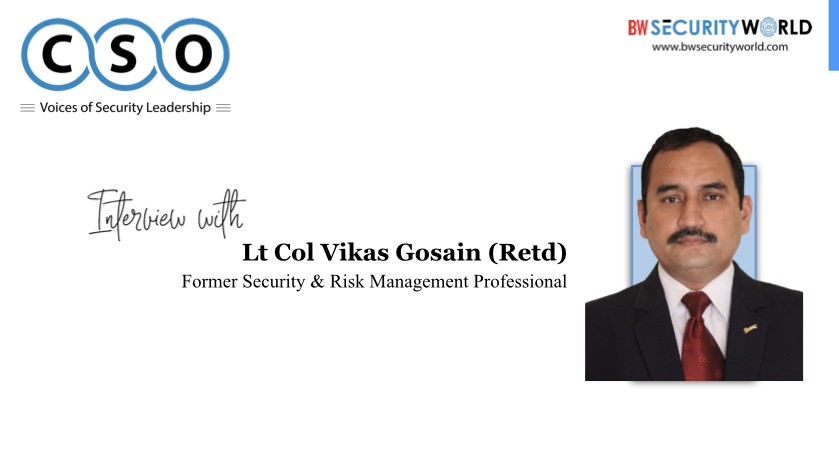
Lt Col Vikas Gosain (Retd) on resilience, innovation, and the evolving role of the CSO
In an era where businesses increasingly recognise security not just as protection but as a business enabler, the role of security leaders has evolved beyond traditional boundaries. From crisis management to driving innovation and instilling resilience across teams, today’s CSOs are tasked with far more than guarding the gates.
Lt Col Vikas Gosain (Retd), who has led security for some of India’s most prominent real estate players, offers valuable insights into how leadership, foresight and innovation can transform security from a cost centre into a cornerstone of business success.
You have been in the lead security role for some of India’s most prominent real estate players. How do you balance the role of a protector with that of a visionary leader driving security innovation?
Security, in my view, is not merely a protective shield but an enabler for the smooth conduct of a company’s core business. In real estate, especially, efficient and visible security often becomes a deciding factor in attracting potential customers, as people naturally gravitate towards environments where they feel safe.
Balancing protection with leadership requires staying constantly abreast of innovations and incorporating them judiciously into existing frameworks. Innovation and security are not separate silos—they complement one another. To be an effective CSO, one must understand organisational needs, align them with available technology, and introduce solutions that are both effective and financially sustainable. Security leadership is not about buying the most sophisticated system; it is about integrating the right innovations that genuinely enhance resilience and client confidence.
Real estate is a high-profile and high-risk sector. How do you cultivate resilience in both your team and yourself when navigating high-pressure situations?
For me, personal resilience begins with situational awareness. By constantly scanning for risks, one ensures that crises are rarely unexpected. When they do arise, it is essential to remain calm, decisive, and to draw on both past experiences and the wisdom of trusted mentors and advisors. High-pressure moments should not be viewed with dread but as a test of professional competence and leadership.
With teams, resilience is best nurtured through meaningful training and regular crisis simulations. These exercises ensure that when real situations occur, the pressure feels familiar rather than paralysing. Clearly defined roles and responsibilities provide every team member with clarity and confidence, while open channels of communication encourage them to flag risks
or weaknesses in the system. After-action reviews following crises are invaluable in embedding lessons, and I firmly believe that ensuring the general wellness of the team is non-negotiable. A burnt-out team cannot remain resilient for long.
Many CSOs talk about “security as everyone’s responsibility.” How do you translate that into practical day-to-day engagement across departments in an organisation?
It is a philosophy I strongly believe in. Security cannot be confined to one department; it is most effective when it becomes a collective responsibility. In practice, I ensured this through daily morning briefings—first with my immediate team and then with other departments. These discussions not only allowed us to share updates but also made security a part of daily organisational consciousness. Mistakes or gaps identified were never treated as failures, but as inputs for improving systems. Over time, this consistent engagement built a culture where everyone—from operations to administration—felt accountable for security.
Can you share an example where your crisis management skills directly influenced business continuity and client confidence in an organisation?
Yes, one incident that stands out occurred at a restaurant within the premises of a property I was responsible for. A brawl had broken out between a group of guests, creating the potential for serious damage and reputational fallout. However, thanks to the tabletop exercises we had conducted earlier, the team knew exactly how to respond. Each member was clear about his role, which allowed the situation to be defused swiftly and without property damage.
The quick and coordinated response reassured patrons, and word spread about the efficiency and professionalism of the security team. What could have been a disruptive crisis was transformed into an opportunity to build confidence among clients and visitors.
What advice would you give to aspiring security leaders who aim to work at the scale and complexity of organisations you have led?
I would tell them to begin with clarity of goals. Once your goals are defined, your work ethic and daily priorities naturally align. Time is the same for everyone, but how efficiently you utilise it determines your effectiveness.
In addition, no amount of reporting can replace the value of physical presence. Security leaders must regularly visit sites to gain first-hand understanding of challenges. A leader who remains visible and accessible earns both credibility and accurate insights. Above all, they must cultivate discipline, decisiveness, and humility—qualities that define leadership in both the military and corporate worlds.
In your opinion, what will be the single biggest security challenge for real estate in the next decade, and how are you preparing for it today?
The greatest challenge will be the integration of fast-emerging technologies into existing systems. Every year, new solutions and equipment flood the market, but procurement for the sake of novelty can quickly become a wasteful expenditure.
The real task for future security leaders will be to identify what technologies are genuinely required for their organisation and whether they will seamlessly fit into existing infrastructure. Preparing for this means developing a sharp understanding of both technological trends and organisational needs, and being able to strike the balance between innovation and practicality.
About the Interviewee:
Lt Col Vikas Gosain (Retd) brings over three decades of rich experience across the Indian Army and the corporate sector. During his 21 years of service with the Army, he held multiple administrative and operational roles, including responsibility for the security, safety and administration of more than 3,000 personnel in J&K.
Transitioning to the corporate world, he held senior security and risk management positions with leading organisations such as DLF, Bharti Realty, Mitkat Advisory and Reliance, where he successfully designed SOPs, spearheaded audits, strengthened processes, and mitigated recurring risks. His leadership also extended beyond security into operations, facility management and enterprise risk consulting.
A versatile professional with a keen eye for detail, he has consistently demonstrated how discipline, foresight and innovation can transform the practice of security into a true enabler of business growth.
Disclaimer: Views expressed are in individual capacity and must not be treated as employer’s views.