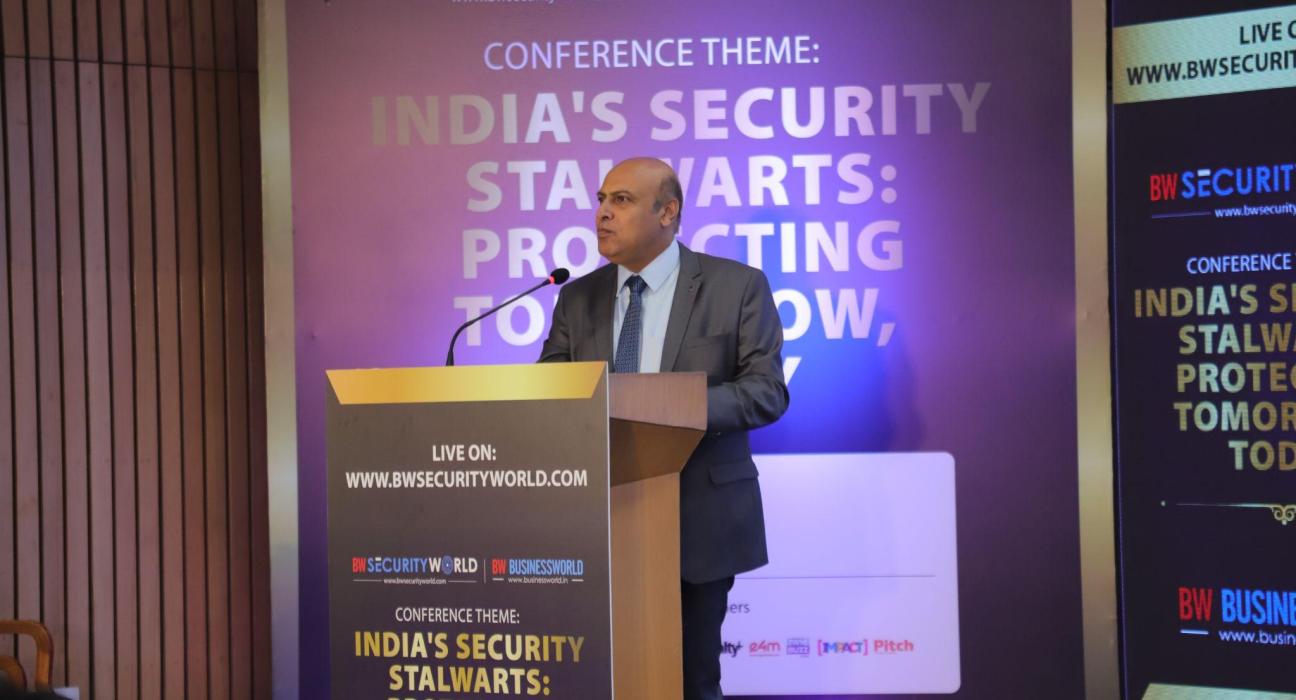
Capt. Sanjay Sharma, CSO, WIPRO, highlighted that the integration of AI in corporate security is transforming the field into a technologically advanced and efficient practice
In recent times, corporate security has changed a lot. There’s a rise in threats, especially in the cyberphysical realm. To tackle this, many companies are turning to AI. It helps predict and detect risks quickly, protecting valuable data and systems. This blend of AI and security is reshaping how businesses safeguard themselves, emphasising the need to adapt and innovate to stay secure.
Capt. Sanjay Sharma talked about corporate security as no longer just about guarding assets and information. It’s now a technologically advanced and financially informed practice. This shift means security is evolving from a cost centre to a business value hub. CSOs and corporate security teams play a crucial role in delivering smart outcomes for business units, employees, and clients. At my company, we manage around 1400 top global clients and a large employee base, ensuring efficient security deliverables and better asset utilisation.
Drivers of Transformation
Sharma pointed out that the transformation in corporate security is driven by three main factors. First, the high speed of impact from security incidents, especially those of global or regional significance, Second, the severity of consequences, both in the cyber and physical realms. Lastly, it is high time to recover from such incidents, particularly those ongoing in regions like the Middle East.
Evolving Threats
Sharma highlighted that the nature of threats is evolving, with cyber-physical risks becoming more prevalent. Geopolitical shifts also influence corporate security strategies. “New risks such as deep fakes and AI-induced fraud are emerging, creating challenges for finance departments and necessitating adaptations in security protocols,” he added.
Corporate security functions must adapt to changing environments by handling risks and responses on a global scale. Security leaders need to converse with various departments like CSO, HR, and ERM. Organisational structures are shifting from hierarchical to metric-based models, emphasising the creation of centres of excellence in areas like geopolitical risk, physical security systems, and regulatory compliance.
Operational Shifts in Security Management
Sharma advised that operational adjustments are crucial for effective security management. He advocated that integrated systems, predictive analysis, and cyber defence around IoTs are essential. Security functions consume vast amounts of data, necessitating robust data privacy and encryption practices. ”The adoption of AI can improve efficiency, advanced threat protection, and skill development within security teams,” he added.
AI adoption in security functions offers several benefits. It improves efficiency, advanced threat protection, and skill development. AI helps in predictive analysis and forecasting, reducing false alarms, and managing data privacy effectively. Organisations can optimise costs and make smarter, faster decisions using AI-driven data analytics.
Emerging Opportunities
New opportunities are emerging in security services, such as security monitoring, cybersecurity managed services, data management, and cloud services. These areas provide business advantages for companies willing to invest in them.
Sharma pointed out that generative AI, including technologies like ChatGPT, offers significant potential for physical security. Synthetic training data, simulation, predictive modelling, and generative adversarial networks (GANs) can enhance security functions. These technologies enable advanced anomaly detection and privacy protection, contributing to more efficient and secure operations.
Adopting AI in security comes with risks. Cybersecurity issues, privacy concerns, and the high cost of implementation are significant challenges. Ensuring the quality of the data used in AI models is crucial for accurate predictions. Regulatory compliance with data protection laws like GDPR and India’s DPDP Act is essential to avoid severe penalties.
-By Musharrat Shahin