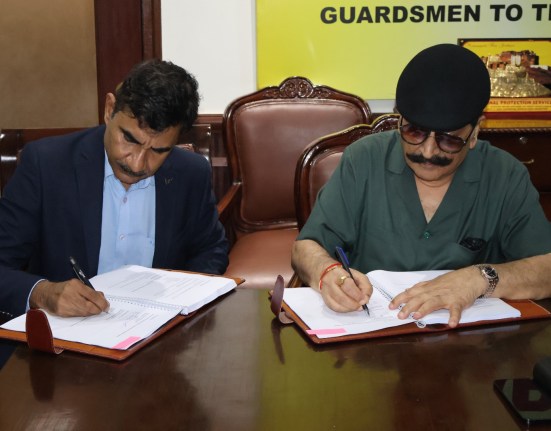
CISF personnel posted at the airport, many of whom are from different parts of the country, are being trained in Bengali to improve communication with passengers
Passengers at Kolkata airport are now experiencing faster security clearance, thanks to small but effective changes implemented by the Central Industrial Security Force (CISF). The new measures focus on better communication and streamlining processes, resulting in shorter queues at security check-in counters.
Until recently, CISF personnel would generally ask passengers to remove objectionable items from their hand baggage and place them on the tray before scanning. However, they now specify certain items such as knives, lighters, and other security restricted items (SRIs), making the process clearer and quicker.
Ajay Kumar, Deputy Inspector General of CISF in charge of Kolkata airport, explained that this approach has significantly reduced the time taken for hand baggage screening. “The person at the point where passengers are keeping their bags is announcing the specific SRIs that passengers should remove from the bags and keep on the trays. Removing these items after the screening slows down the process,” he said. “The queue has been reduced significantly now because of the small changes that have been introduced.”
In addition to this, CISF personnel posted at the airport, many of whom are from different parts of the country, are being trained in Bengali to improve communication with passengers. According to Kumar, teaching them basic Bengali phrases—such as instructions to hold the boarding pass in hand or to place electronic or metal items on the tray—has helped reduce confusion and save time.
“The challenge was not a lack of manpower but managing resources efficiently,” he added. Currently, around 2,200 CISF officials are deployed at Kolkata airport. Training has also been provided to ticket-checking staff and those monitoring the screening machines, ensuring quicker passenger movement.
For frequent flyers, the changes have brought some relief, although peak hours still see significant waiting times. Debashis Chakraborty, who travels almost every week, noted, “When I am travelling between 7am and noon, I know it will take me at least 45 minutes to get the security clearance.” Another regular traveller to Mumbai shared that security checks usually take between 30 to 40 minutes, though post-8pm flights tend to see lesser waiting time.
One persistent challenge, Kumar pointed out, is passengers carrying more than the permitted cabin baggage. While the rule allows one piece of cabin baggage per passenger, many still bring multiple bags, leading to delays. “We have to explain to them that they are not allowed to do so. This used to take a lot of time,” he said. CISF has requested airlines to strictly enforce the one-person-one-bag rule, which has helped ease processing times.
The announcements came on the sidelines of an event to mark the 56th CISF Day, during which the security force revealed plans to organise a Coastal Cyclothon from March 7 to April 1. The initiative will see 125 cyclists covering 6,553 kilometres along India’s coastline, beginning simultaneously from Lakhpat in Gujarat and Bakkhali in Bengal, and concluding at Swami Vivekananda Memorial in Kanyakumari.
“We want to connect with the people,” said Shikhar Sahai, Inspector General, CISF, North East Sector II, which covers Bengal, Odisha, Jharkhand, and the Andaman & Nicobar Islands. Kumar Pratap Singh, Deputy Inspector General, North East Sector II, was also present during the event.
While the Coastal Cyclothon aims to strengthen public engagement, the recent operational changes at Kolkata airport reflect CISF’s broader focus on improving efficiency and passenger experience through practical solutions.