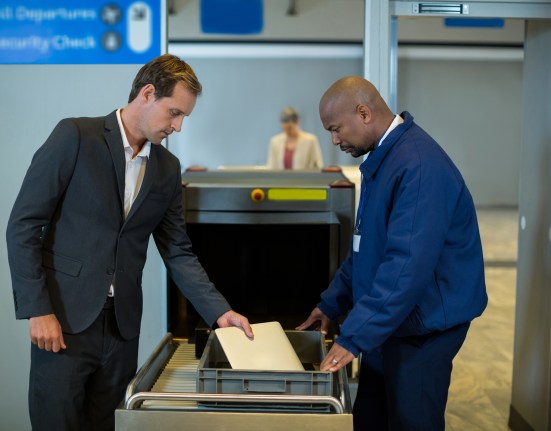
Under this agreement, passengers arriving at an airport in one country with a connecting domestic flight would not need to be rescreened, and their checked bags would automatically transfer between aircraft
6The US Transportation Security Administration (TSA) is proposing a unique “one-stop agreement” with India to eliminate the need for rescreening passengers and baggage, which could enhance global aviation security standards. TSA Administrator David Pekoske discussed this initiative at the India US Aviation Summit on Tuesday.
Pekoske explained that the one-stop security concept would streamline the flow of passengers and baggage by removing duplicate security checks at transfer points. “I think very tangible and very reachable between India and the United States is one-stop security,” he said.
Under this agreement, passengers arriving at an airport in one country with a connecting domestic flight would not need to be rescreened, and their checked bags would automatically transfer between aircraft. Pekoske emphasised the potential benefits, stating, “Flights inbound to the United States are more secure. If there’s a reverse agreement between the United States and India where US screening satisfies Indian requirements, that means that flights to India would also be more secure.”
Pekoske noted that such an agreement would require regular information exchange and improvements in security processes. He highlighted several advantages, including reduced security costs, shorter connection times, fewer missed connections, and an improved passenger experience.
To facilitate the sharing of sensitive security information, Pekoske suggested that India and the US sign a memorandum of agreement. He explained that while this information might not be classified, it still requires additional protection.
Reflecting on the origins of both nations’ transportation security measures, Pekoske mentioned the 1985 Air India Flight 182 bombing and the 9/11 attacks in 2001 as pivotal events that reshaped their security approaches.
US Federal Aviation Administrator Michael Whitaker also addressed the summit, emphasizing the need for India and the US to collaborate on aviation safety. He stressed that safety is a collective effort and that sharing data between the two countries could help identify and mitigate risks more effectively.
“Our (US and India’s) national systems of aviation are inextricably linked into a single global network,” Whitaker said. He noted the interconnectedness of air spaces, supply chains, and international services, highlighting the importance of cooperation in enhancing global aviation safety.
Whitaker pointed out that the aviation sector has seen significant improvements in safety over the years, moving from learning from accidents to proactively analyzing data to prevent failures. “Our challenge is to bring safety to the next level, and that means we need to proactively analyze data and find those risks of failure and mitigate those risks before they happen,” he said.
As new technologies and entrants emerge in the aviation sector, Whitaker underscored the need for regulators to adapt quickly. He called for a balance between innovation and safety, stating, “We have to find a safe yet nimble way to regulate these new entrants who are operating at the speed of a startup while we are operating at the speed of government.”