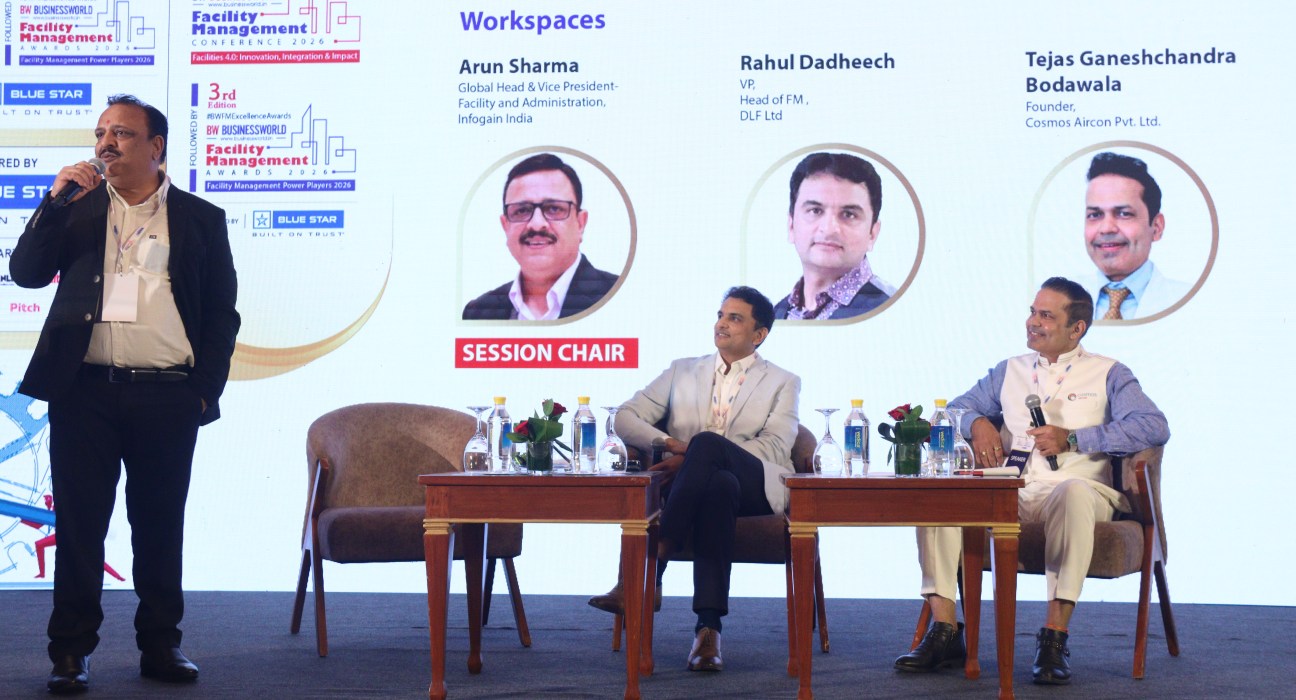
Industry leaders at BW Facility Management Conference 2026 highlight the growing role of wellness, indoor air quality and hybrid work strategies in creating healthier workplaces
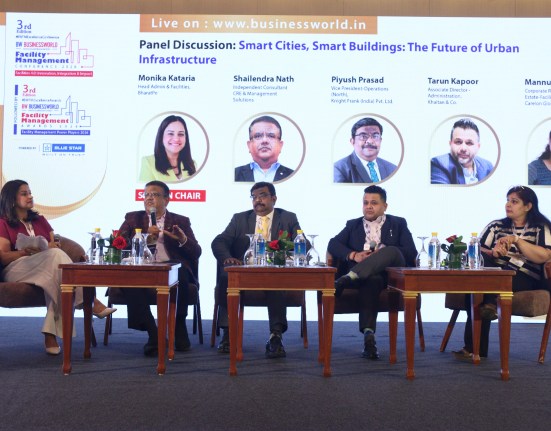
At the BW Facility Management Conference & Excellence Awards 2026, a thought-provoking panel discussion on “FM and Wellness: Creating Healthier and More Productive Workspaces” brought together industry leaders to examine how facility management is increasingly shaping employee well-being. Moderated by Arun Sharma, Global Head & Vice President – Facility and Administration at Infogain India, the session featured Rahul Dadheech, VP & Head of Facility Management at DLF and Tejas Ganeshchandra Bodawala, Founder of Cosmos Aircon. The discussion highlighted how wellness has moved from being a secondary concern to a central pillar in workplace strategy, particularly in the post-pandemic era.
Setting the tone, Sharma emphasised the shift in mindset around wellness, noting, “Wellness is something we all talk about, but in the last six to seven years—especially post-COVID—people don’t just want to talk about it, they want to live through it.” He underlined the importance of making wellness an interactive and evolving concept,
Addressing when wellness should be integrated into facilities, Dadheech stressed that it must begin at the very foundation. “We start from scratch, from the design stage itself. But it doesn’t end there—design is done once, while operations evolve every three to five years,” he said. He described facility management as an inherently inclusive function that influences every touchpoint of the workplace, from entry experience to infrastructure and environmental comfort.
Indoor air quality (IAQ) emerged as a central theme during the discussion, with Bodawala highlighting the shift in industry priorities over the years. “In 1998, we were convincing people to install air conditioning. In 2026, air conditioning is a given, now people are concerned about indoor air quality,” he said. He pointed out that maintaining optimal levels of PM2.5, carbon dioxide, and volatile organic compounds is essential for creating healthier indoor environments, adding, “If you provide clean air, your occupants will feel good, and that directly improves performance.”
The panel also focused on practical solutions for organisations operating in legacy buildings. Bodawala noted that significant improvements can be achieved without heavy investments, stating, “Existing systems can be retrofitted with minimal budgets.” Echoing this, Dadheech emphasised the importance of ongoing management, saying, “Operations play the most important role because they continuously adapt to changing expectations and standards.”
Bodawala pointed out how industry priorities have shifted over the decades, “In 1998, we were convincing people to install air conditioning. In 2026, air conditioning is a given, now people are concerned about indoor air quality.”
He underlined measurable benchmarks for healthier indoor environments: (a) PM2.5 levels around 50, (b) CO2 levels below 400 ppm, (c) Controlled VOC levels.
“If you provide clean air, your occupants will feel good—and that directly impacts performance,” he noted.
Beyond physical infrastructure, the discussion expanded to include mental and emotional well-being, particularly in the context of hybrid work models. Sharma raised a critical point, asking whether employees are truly engaged beyond just physical presence. He noted that modern workplace wellness must address mental engagement and evolving employee expectations, especially as hybrid work increases screen time and reduces direct interaction.
On the question of return on investment, Dadheech offered a broader perspective, highlighting the intangible benefits of wellness initiatives. “Not all ROI is direct. Investments in wellness build trust, satisfaction, and brand reputation—that’s the real return,” he said, pointing to how ecosystem-driven developments enhance long-term value for organisations.
The session concluded with actionable insights for facility managers, including improving IAQ monitoring, adopting cost-effective filtration solutions, and integrating green spaces into workplaces. Bodawala emphasised the fundamental nature of clean air, stating, “Good air is a basic right of every occupant.” Sharma closed the discussion by reinforcing the need for adaptability, noting, “Wellness is not a one-time initiative, it is an ever-evolving process,” underscoring the dynamic role of facility management in building healthier and more productive work environments.
By: Nikhil