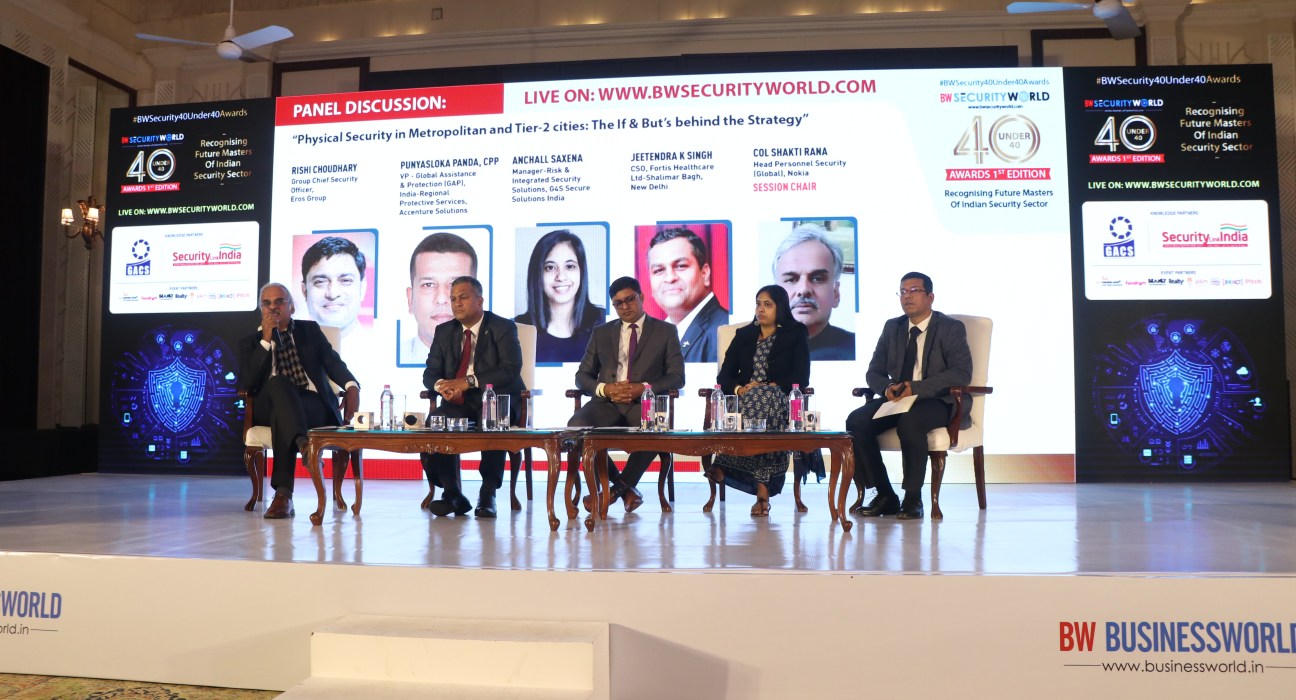
This session addressed certain security measures in all forms and levels of security, to create a valuable strategy with flawless outcomes
A panel discussion on the strategy of how to manage physical security in metropolitan and Tier-2 cities, kicked off with the opening comments of the session chair – Col Shakti Rana, Head Personnel Security (Global), Nokia, talking about the need for further excellence in Indian security. He said that the topic was extremely important and that there is lack of planning and limited resources, which need to be taken seriously. Moving on he mentioned that, “We, as corporate security can pitch in very well, as we are security professionals. We can be the synergy between the corporate and the police force and internal security teams.”
According to Rishi Choudhary, Group Chief Security Officer, Eros Group, “Cities are made of organisations, residential societies, factories or the entities running the business. Once these entities are secured, a city can be more aware of security threats.” He also said that over the last few years, the possibilities of terror attacks or natural disasters revealed that the damage can be mitigated at organisational levels as well. Physical threats can lead to huge financial losses also.
Moving on, Punyasloka Panda, CPP, VP – Global Assistance & Protection (GAP), IndiaRegional Protective Services, Accenture Solutions mentioned that a crowd is a soft target, and irrespective of the size of the city, what matters most is that efficient crowd management needs to be done. He also stated that, “When I say crowd management, I mean that it is recognising the crowd. If we see examples of large cities which are densely populated, even if the crime rates are very less in these cities, like Seoul, South Korea and Tokyo – the reason why they have been so strong in their safety and security part for the citizens was, an extensive network of CCTV cameras. They adopt the strategy of artificial intelligence in those cameras such facial recognition systems and advanced analytics, which helps to identify the miscreants.” He stressed on the need for a stronger surveillance system.
Anchall Saxena, Manager-Risk & Integrated Security Solutions, G4S Secure Solutions, India, focussed on risk management in metropolitan and Tier-2 cities mainly. She said that, “When we talk about physical security, what I feel is that sometimes we avoid risk management. We know the risks present, threats to Tier-1, Tier-2 and Tier-3 cities, but the problem is that as an organisation or me as a service provider, what we forget is to manage risks.” She also went on to state that a lot of security systems have been placed in cities, but the problem is where we do not know where to put in our system and integrate them whilst taking advantage of our risk management systems in the right way.
Exploring another angle, Jeetendra K Singh, CSO, Fortis Healthcare – Shalimar Bagh, New Delhi, said that since 2008 till present day a lot of protocol and procedural changes have happened. The National Accreditation Board for healthcare has brought in a lot of processes and changes in the way hospitals operate during emergencies, for example a bomb blast. He went on to say that, “When victims are got into the emergency section, a certain code is announced all over the facility and the entire senior management are informed immediately about the incident and every department head rushes to the hospital.”
This session was held at the BW Security World of BW Businessworld, 40 under 40 summit and awards. According to Col. Shakti Rana, he sees a lot of soft targets, and miscreants also see only soft targets. He concluded the session by adding that, “All the metropolitan and tier – 2 cities are actually a playing field for miscreants, be it a small time thief or a person responsible for serial bomb blasts.”